Saturday, March 19, 2016

Bunny Army


Snow in the forecast Sunday into Monday, so March's balmy lamb is going out with teeth and claw.  Yet, my lilac tentatively opens its leaves, the hyacinth bloom in the shelter of the spruce, the daffodil fill out their buds before bursting into lionine heads.  Chickweed and dead nettle flowers feed the early pollinators.  I leave them in the garden, except in the raised beds at school where we've planted beets and transplanted strawberries.  Snow or no snow, spring is coming!

Here's an annual favorite of mine.  I've been growing arugula and pea micro greens, which I will add to the "bunny bed" when I make this next week.  My two barred Plymouth Rocks are laying again, and I hope the white Araucana will bless us with her blue eggs.  

March 17th Rainbow


It's been a lot of things at once in my life, good and bad, at work and at home, and with friends.  I've been overwhelmed.  Yet, the sun shines and tomorrow and tomorrow and tomorrow comes.  I may put off planting today, but I will go outside.  Time is precious.  Every day should be lived alive.


Order my cookbook here.


Friday, March 4, 2016

Seed Saving

I'll admit it.  I have them everywhere.  Stuffed into the box my amaryllis bulbs came in.  In a reusable canvas bag.  In a padded manila envelope.  Then just yesterday, I discovered a huge bag in the back of my garage...

I need to organize my seeds!

February was a whirlwind of birthdays, time with my daughter, both of us sick at different times, art show preparations, scientific inquiry, and of course my regular "job".  I returned to work after a Family Sick Day taking care of my coughing little one, checking how the sub had left things and prepping for the day, squeezing in a meeting and morning duty before my first two classes.  When I went back to the office, I found I had received a package.  What is this, I wondered?  I couldn't remember ordering anything except the wheat grass I just planted this evening in a clam-shell salad container as micro greens and a stream macro-invertebrate science kit generously funded by the Barrington Land Conservation Trust I happily dissected Wednesday that my third grade Eco-Warriors will use this April in collaboration with eighth graders visiting from a nearby school.  

I  brought the box back to my room.  I had 15 minutes before my next class arrived and I hastily cut a watermelon, pea pod, corn, and bean to show the kindergartners different foods that contained seeds that they would be cutting out and drawing seeds onto with crayon.  It was a shape lesson (circles, ovals, and semi-circles, with "bean" shapes the challenge of the week) and a science lesson (plants have different parts; which parts of the plant do we eat?).  I taught the brand-new lesson, tying in with the healthy foods theme for our district in March, which followed fruit and vegetable ABC squares done with textured paper the kids made, cut, and glued, making a food that went with their letter and with help, spelling it (art and literacy).  After lining them up and getting the room clean (again), I opened the package.


A seed sorting kit!  What???

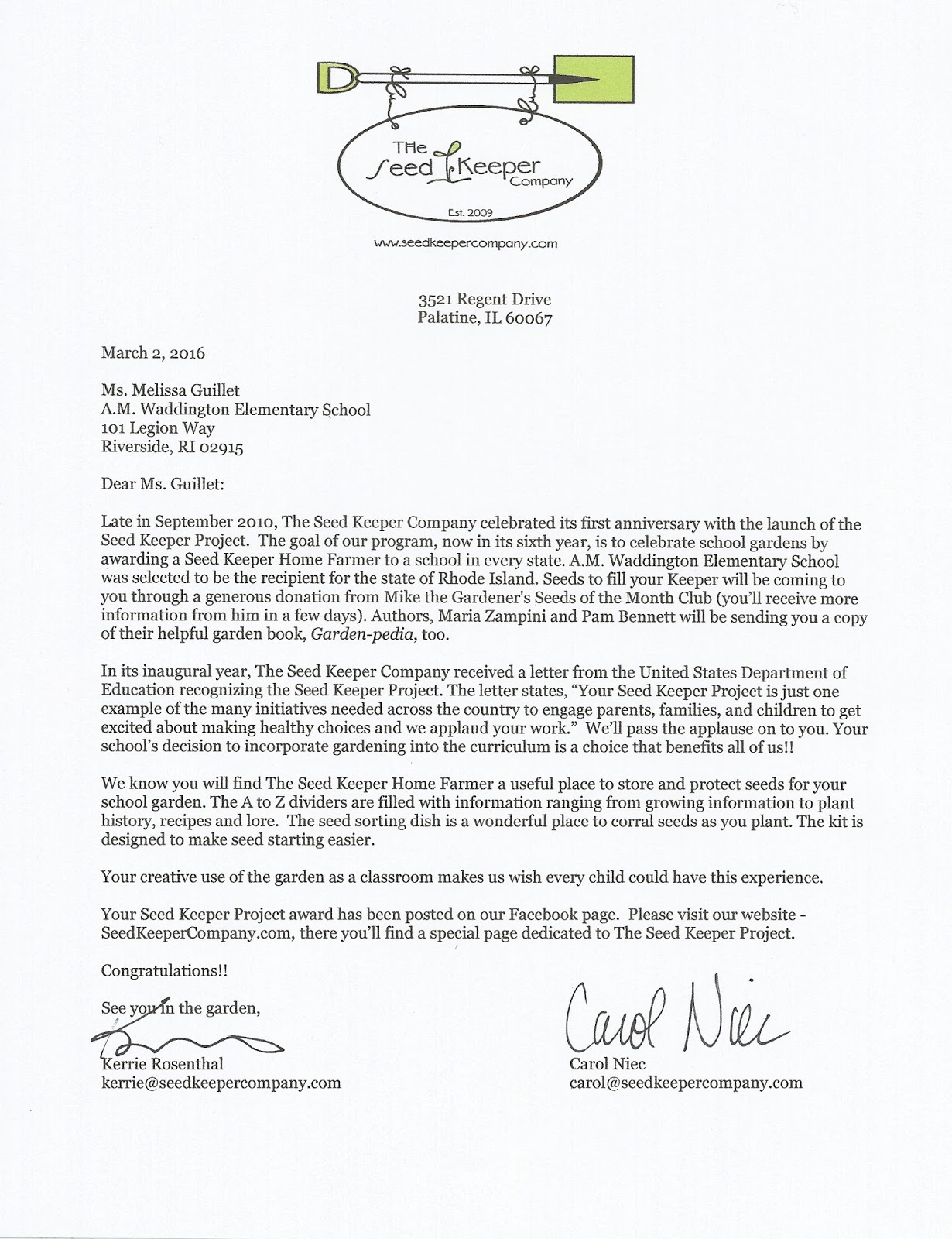
It came with this letter:


Wow.  Just wow.  I guess the word is getting out about what I'm doing.  I have more people visiting the school in the spring, one to write her thesis on school gardens including ours.  Last year, Whole Foods wrote an article about us.  Tomorrow, I'll be putting final edits on a piece for Natural Awakenings.  I recently joined RIEEA, and the resources and connections are multifold!  My mind is exploding with possibilities.  I need to breathe!  

I am so grateful, so overwhelmed by all the support!  I have many more exciting projects in the works.  


When those seeds get sorted, some will be too old to use.  I will sort some into plastic bins (found cheaply at Job Lot) for scientific study and art fun.  The first graders will be recreating Van Gogh's sunflowers and irises in collage, cutting circles, triangles, rectangles, and hearts, then folding or curling the petals and leaves for a 3-D effect.  They will also learn plant parts and glue some of those expired seeds inside their flowers.  Link to the lesson here.

Meanwhile, I have seeds to sort!

Update:


Finally sorted my seeds.  I had way too many to fit in there, but i think the average home grower should have enough room.  The velcro dividers are easy to move.  I turned some sections sideways to better fit.  They're in alphabetical order, so sunflowers are with squash.  With so many annual flowers of many names serving similar purposes, I just filed them under "flowers".  Overall, a nifty way to organize seeds for our school garden!  Thanks again, Seed Keeper Company!


Monday, December 28, 2015

Science with a Store Card and a Supermarket Coupon (Nematode Whip and Nae Nae)


Because you never know when opportunity will strike...

The unusually warm weather of this December and the purchase of a home microscope have made me ambitious, scraping trees of moss and lichen, looking for tardigrades.  I first used the microscope kit's rather dull scalpel and a bill envelope to collect samples from the large oak on my property, as well as some off a pine in the woods nearby.  But when I took my daughter to Fargnoli Park December 26th (it was in the 50s), I realized I was potentially missing an opportunity.

I had travelled light, wearing only a sweater and cargo pants, none of my usual tools I stuff in my pockets on me.  Yet, here was an expired coupon I had been using as a bookmark in my Game of Thrones book and here on my key chain was one of several store cards that get scanned on my trips there.  I folded up the coupon to make a crude envelope as I walked passed several sycamore trees.   Gently I scraped the soft yellow-green lichen and pulled out an elusive piece of moss from inside the grooved bark of an enormous oak tree. 

The bit of moss was the 3rd one I tried for, after dropping the first two into oblivion.  I tucked the envelope into my right front pocket and my daughter and I continued our play on the swings and see-saw.  Back at home, I removed the folded paper and placed it on a book shelf.  Later, I used the lid of the petri dish (the base was already occupied with yard samples) to add bottled water for it to sit in overnight.  Tardigrades and many other microscopic animals are aquatic.

To best view my finds, I used the method recommended by Mike Shaw:


I took a lot of blurry photos with my cellphone shaking over the microscope viewer.  I will work on a better system.  But for now, I thought I'd share some of my findings:


Early photo of moss from ground.  No critters I could see.
Thought the white image in center was a tardigrade.
Adjusted focus and lighting and as it never moved,
decided it was part of the moss.


First images of moving creatures.
Have since identified as a rotifer.
Two creatures continue to move,
standing up and swaying.
One on right goes behind moss
briefly, then reappears.

Still not sure what I found.  Any answers out there?  Looking up rotifers now...

Edit: It WAS rotifers!!  Hoping to get better pictures next time.  Keep exploring!

More pictures and video below:

Base of seed from sycamore seed ball.


Something speedy...


Rotifer moving about petri dish.

Nematode doing the whip and nae nae:


Sunday, November 15, 2015

A Study in Scavenger Hunts

Something is afoot!  The leaves are falling, the year is winding down, yet the evidence is everywhere!  What clues can you look for that animals have been present?

My third grade students looked for these clues on an unseasonably warm day in November.  It had been raining earlier in the week.    The ground was covered with fallen leaves.  Previously hidden nests were revealed in the exposed branches.  Tracks filled the soft earth.

With pencils, clip boards, data sheets, and scat and track guides, we went exploring.  We looked in three locations: school garden, oak grove, and creek.  Would we find evidence of animal shelters, tracks, scat, eaten food?

What's under here?
Is this a home?
How about this?
Found something!

Who lives here?

What's that?!

Give me shelter!

Scat!  Deer scat!

Bark beetles set up their edible hotel.

"There's a feather in there!  Must be a bird's home!"

"Is that a home?" "No, my little brother made that."

Is this the key hole?

Mushrooms eat the wood.

Who ate this?  Squirrel or chipmunk?

We found leaves eaten by caterpillars earlier in the year.
Some thought they were worm holes.  We're always learning more!

We drew pictures of our finds and took notes.
What else did we learn and discover?

Conduct your own investigation with the resources found here.

Sunday, October 25, 2015

Gluten-Free Stuffing and More!


Thanksgiving is coming!  I'll be doing a FREE workshop MONDAY on cooking with local ingredients, including TWO gluten-free stuffings!  Reduce your carbon footprint, save money, improve your health, save the world with these world-cuising recipes using New England-sourced ingredients.  There will be samples of pumpkin polenta, stuffed squash, apple parsnip soup, firecracker cabbage rolls, and Jamaican ginger apple carrot bread.  Plus, you get to try acorns!

Monday, October 26th
6 p.m.
Harmony Public Library
195 Putnam Pike, Harmony, RI 02829
(401) 949-2850

Monday, October 19, 2015

Free Food Workshop

World Cuisine with Local Ingredients:

Love to eat around the world?  Master Gardener, cook, and author Melissa Guillet will take you through four seasonal fall recipes featuring local ingredients.  Get a taste of Jamaica in a gingery bread, try the firecracker flavor of China, indulge in an Irish apple and parsnip soup, and rediscover pumpkin with Italian polenta.  Recipes will be available to take home.  Don't miss this unique event!

Monday, October 26th
6 p.m.
Harmony Public Library 
195 Putnam Pike, Harmony, RI 02829
(401) 949-2850

Tuesday, October 6, 2015

What's a Weevil? (Plus: How to Eat Acorns)


Er...What IS THIS on my house?  It's tiny.  It's weird.  It's got this snout and heart-shaped feet.  It is WEEVIL!!!!

What is a weevil?!!

Curculio glandium is a beetle with a long snout called a rostrum.  There are boll weevils, potato weevils, acorn weevils...  This is an acorn weevil, and in this mast year for acorns, it is very happy.  It will bore into acorn shells to feast, as well as lay eggs.  The eggs are laid after the female bores a hole into the acorn's center, then the nut heals over the hole.  By the time the acorn falls from the tree, the tiny larva is ready to bore its way out and dig as deep as a foot underground to live up to five years before pupating into an adult.  More info here and here.

Weevils aren't the only ones who eat acorns.  So dgray squirrels, blue jays, black bears, chipmunks, ruffed grouse, deer mice, and people.  I have two oaks in my yard and plan to harvest some of those acorns for some yummy pancakes and brown bread.  There are approximately 58 species of oak trees in the United States, with white and bur varieties producing the biggest acorns.  A single tree can yield over 29,000 acorns in a good year.  But acorns don't come ready to eat...

Acorns are high in tannins, which naturally occur in many plants, including grapes.  Tannins are bitter-tasting and too much will interfere with kidney function.  Red and black oak have the highest tannins, white oak the least.  Not coincidentally, red and black oak acorns take two years to sprout, thus storing well for animals, while white oaks sprout quickly and being sweeter, are quickly eaten up by animals fattening up before winter.  But all are edible with this process: water soaking.

The squirrels figured this out by burying acorns for later and letting the rains soak and resoak them.  By the time winter arrives, they are a lot more tasty!  Native Americans stored them in baskets they weighted down in rivers and streams, letting the current do its work over several weeks.  Today, we can boil the nuts and change out the water.  First, crack the shells with nutcrackers, discarding nuts with holes, rot, or visible larva.  Place in a large pot with clean water.  Bring to boil.  The tannins will turn the water black.  Drain the water and replace with fresh water.  Repeat boiling and draining until the water stays clear.  The acorns are now ready for roasting.  Roast in oven at 375 until aromatic.  They have a taste similar to hazelnuts.

Once roasted, they can be ground as flour, added to batters, or baked into bread.  Here's the recipe from my new cookbook, Around the World in 100 Miles:

Wild Option
________________________________________________

Mercy Brown Bread
Taste of Old New England
________________________________________________

Prep: 10 minutes Cook: 2 hours Makes 3 loaves

1 cup processed acorns (see page 134) or raw hazelnuts
1 cup buttermilk
1 cup plain yogurt
1/2 cup molasses
1 cup fresh cranberries
1 cup unbleached flour
1 cup whole wheat flour
2 tsp. baking powder
1/2 tsp. salt
1 tsp. cinnamon

Combine nuts and buttermilk and run through food processor to make a thick paste. Mix paste with yogurt and molasses. Stir in washed and picked over cranberries, removing stems and soft berries first. In a separate bowl, whisk together flours, baking soda, salt, and cinnamon. Gradually stir flour mixture into wet mixture. Grease three coffee cans and divide batter between them. Seal cans with foil and rubber bands.


Place cans in large stock pot with at least two inches of water. Cover and bring to gentle boil. Steam breads two hours, adding more water as necessary. Allow to cool before removing foil. Slice and serve.