I had scheduled this trip in July for a Saturday in September. As with most Septembers, it was busy with back to school with my nine-year old daughter and for myself as a teacher. The weekends were filling up with festivals and volunteering and I had a meeting later that day. But on September 10th, my daughter and I made it to Rhode Island Resource Recovery to take the bus tour around.
Carol, our guide, was expecting 15, but only one other person showed up. I took advantage of the lack of people to get better photos than I might have. If you haven't gone on this tour (which is FREE, but you must register through their
site), you should.
Welcome to the dump, where a 100 trucks a day dump the trash of Rhode Island residents. They've recently begun Phase Six, which will be the final phase allowable as the landfill must not exceed 250 feet in height for structural soundness and must be so many feet away from all residential and commercial spaces. So basically, soon there will be no place to put the trash.
Also, this is not a dump. It is a landfill. Trash is not simply "dumped" anywhere, but follows a strict system that included ventilation pipes, leachate pipes, layers of soil, sand, and ground ground stone, all carefully arranged with tarps on top, netting to catch loose plastic bags, and pipes to collect methane gas. Let's go in!
Here you can see a representation of the layers. Under soil and sand is the actual trash, which is then on top of a funnel of gravel that leads to a leachate pipe and even more leachate pipes below. (Leachate are the lovely juices the trash leaks.) There's also some heavy-duty plastic liners beneath all that to prevent trash from contaminating ground water. Click the picture to get a better view.
What can reduce this waste? Reusing containers or using reusable containers. Buying in bulk for fewer containers. Not buying items that can't be recycled. Eating more "unpackaged" foods such as fresh fruits. Using a reusable mesh bag for produce and reusable bags for groceries or any type of shopping. Making just one change, such as eating a whole apple instead of apple sauce will not only reduce trash, but reduce unnecessary sugar while adding fiber to your diet!


Let's go in further...

Paper can be recycled and should not go in the trash. This included junk mail, glossy magazines, even cardboard with plastic windows! It does NOT include freezer-food boxes or soda can boxes that are treated to not break down when wet. (You could use these to make collograph stamps or shadow puppets!)
Metal can be recycled! A magnet collects iron, steel, and tin, while an
eddy current repels the aluminum away from the paper, plastic, glass, and other recyclables. Flattened aluminum and plastics can get mistaken for paper, so don't crush those cans and containers! Recycling aluminum saves 95% of the energy needed to mine it from ore (not to mention leaving our beautiful hillsides and mountains alone). A can can be used, put in the recycling bin, collected, processed, sold, and made into a new can in under 90 days!
Glass is a recent addition to RI recycling, as the cost to ship it for processing out-weighed the profitability to do so. RI now ships glass to Massachusetts for recycling. Glass should be containers, not drinking glasses (unless you drink out of Mason jars), broken glass, or light bulbs. This other glass can hurt workers and damage processing machines.
Cartons should be rinsed, but no need to flatten them or remove the cap. The buyer will take them as is. Clean Styrofoam can be brought to the Eco Depot in clear plastic bags.
For plastic, anything under 5 gallons goes in the bin. Stretchy plastic (plastic bags, produce bags, plastic wrap) can be returned to most big stores that give out plastic bags due to a recent law. Look for a blue box at supermarkets, Target, Walmart, Ocean State Job lot, and others. Throw the plastic bags into your canvas or reusable shopping bags so you'll have them when you next go shopping at these places.
 |
Autumn feels how easy it is to pedal when you recycle aluminum.
The energy needed to create aluminum products from ore is much
higher and neither of us could pedal to lift the can above up. |


 |
We sorted these magnets and learned a few things.
Click to enlarge and try yourself! Answers below. |
 |
This table is made out of 100,000 recycled plastic bags!
Note the blue box to collect bags on the right. |
  |
On average, a family of four fills five garbage bins a month.
By recycling, reusing, and composting, they went down to one-tenth of that! |

 |
| Recycled plastic can be made into fleece, backpacks, shoes, upholstery, carpet, and more! |
 |
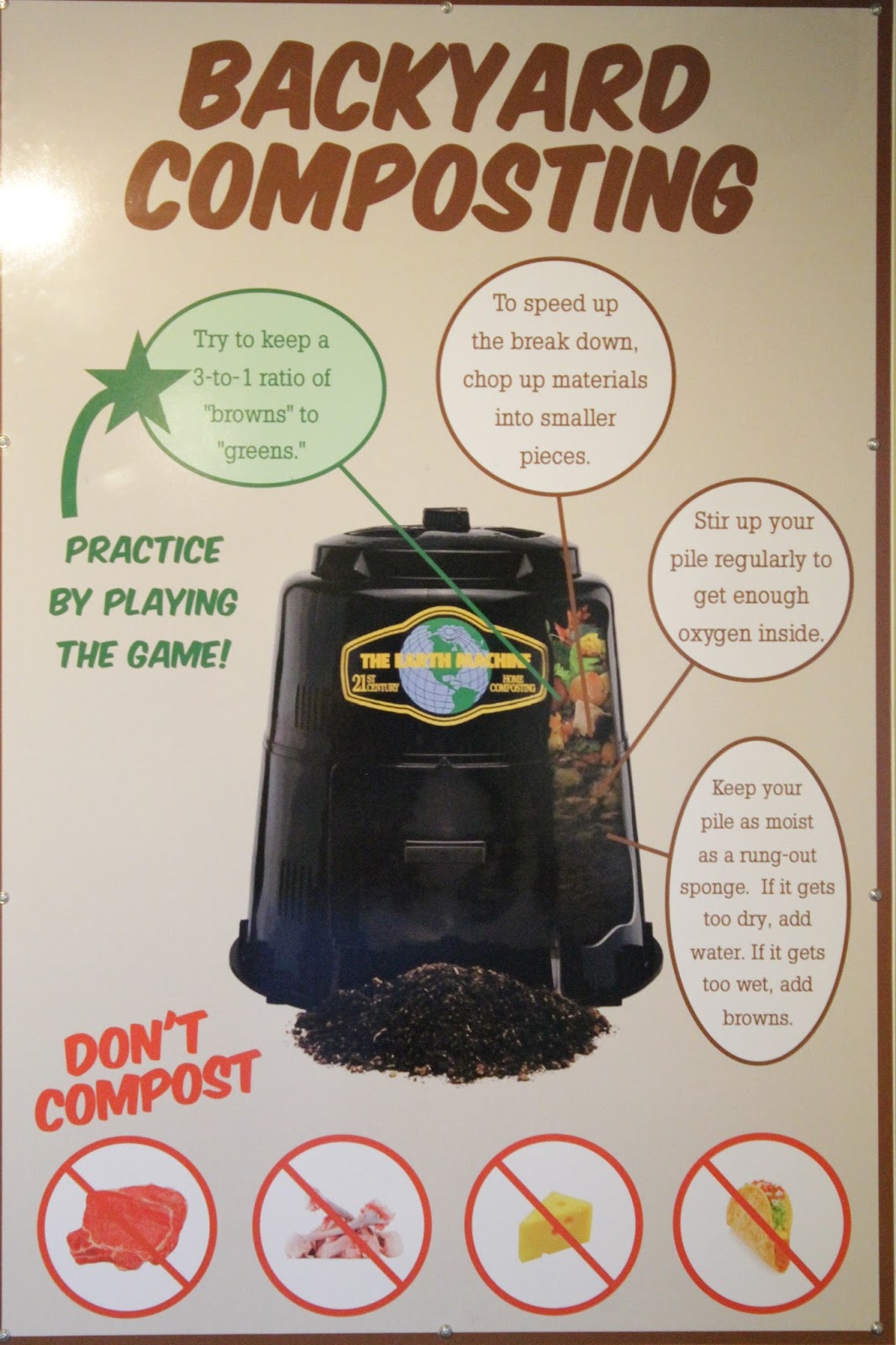
Composting food scraps is easy! You can get a worm bin
or start a heap outside. More info here. |
 |
Autumn tries to get green and brown balls into the right buckets.
Compost needs to have a balance of "browns" (sticks, dead leaves,
newspaper) and "greens" (lawn trimmings, egg shells, coffee grounds,
fruit and vegetable scraps) to create the best environment for aerobic decomposers. |
 |
| Score!!! |
Now we'll go in further...
Behold! The highest point in Rhode Island! The Johnston Land Fill!
(Actually the highest point is Jerimoth Hill, at 812 feet. The hill pictured below is 250 feet.)
 |
| The Eco-Depot, with drive-up drop-off of hazardous waste. Nearby are also drop-offs for televisions, refrigerators, freon-containing items, large cardboard, and bagged Styrofoam. Styrofoam for food must be bagged separately from shipping Styrofoam and they do not accept packing peanuts. They can give you a clear bag if you didn't bring one. |
 |
| Tires get collected here. |

 |
| Skid row? |
 |
| Refrigerators...once... |
 |
| Reasonably priced compost made from yard waste bags. |
 |
| In process... |
 |
| Not the rain maker, the compost maker! |
 |
| Rows and rows of aging compost. |
And surprisingly, life...
 |
| Wild flowers and many yellow butterflies. |
 |
| Tough little sunflower! |
 |
| Pollinator garden planted by a Boy scout troop. |
 |
| A hawk soars in! |
 |
| Turkey vultures. |

 |
And turkeys!!!
There was also a wild dog sighted, but I couldn't get a clear picture of it. It looked like a dingo. I asked if we should alert the zoo to see if they were missing one. Coyote and deer also go through the area. |
 |
| Leachate pipes going into the new and final phase of the landfill. |
 |
| These pipes capture methane that is then converted to power, supplying 2800 homes with electricity. |
 |
| Tarps while layers are in process. |
 |
| More pipes ready to go. |
 |
| Big truck. (Kids like big trucks.) |
 |
| It can be dusty work. The grounds by the buildings are hosed down to keep dust at a minimum. |
 |
| Eventually, Phase 6 will be level with the hill in the background, at 250 feet high. |
 |
| Early stages... |
 |
| Neat and tidy! |
 |
| Supports needed for the tremendous weight of trash! Engineers assess daily. |
But even the best engineering, the best containment, does not address that soon there will not be enough room to put our trash. Unless we ship it out to another state, no other place in Rhode Island is suited to containing very toxic materials safely. It's up to us to create less trash, reuse as much as possible, and recycle fanatically. Do it at home. Do it a school. Do it at work. Insist the companies you buy from, whether manufacturers or restaurants, do it too.
Watch our Youtube video
here.