Showing posts with label environment. Show all posts

Tuesday, May 12, 2020

Wednesday, April 1, 2020

April Fools

If you're like me right now, you've been spending a lot of time at home.  In my state of Rhode Island, the governor has just closed the beaches and state parks because people were not keeping 6 feet away or being in groups of 5 or less.  I've also seen people leaving masks and gloves in shopping carts or on the ground. What kind of fools are we?

There is a silver lining, though.  We're in this together, and together we can start tackling the tough issues that face us by making systemic changes.  One change that needs to happen is reducing food waste.  In RI, food waste accounts for 32% of our landfill!!!  (See the end notes for places in Rhode Island that compost.)

Here's a fun game for the kids: Blind Lemon Nightcrawler, the deep underground jazz musician, wants to open up a new restaurant, the Compost Cafe!  Print out these pages and cut out the food scraps and plates from pages 2, 3, and 4.  Kids can arrange the food for different "customers" and even make menus from brown shopping bags, drawing the food scraps and adding prices and labels. (It's a great way to sneak in spelling and math!)

Don't forget to subscribe on the right to never miss a post!


You can compost at home, under your sink, in your back yard.  Follow the recipe and cut pieces small or put them through a blender.  Mix in to compost and keep damp but not soggy. For indoors in a small container, make sure to drill air holes.  I do this around the bottom to also add drainage and put the container in a larger one.  You can make one from a recycling bin or large Tupperware container.  You'll want red wigglers (Eisenia fetida) for small composting.  Earthworms and nightcrawlers are fine for outside.

If you want to buy worms or a compost bin, I like these vendors:

https://unclejimswormfarm.com/

https://www.wormladies.com/


This activity is part of our "Dirt Pop Up Museum", where we set up several art and science stations for kids to learn more about worms!  Check out our program link on the right or here.  Learn more on your own with the links on the left under "Dirt and Detrivores", then "Worms and Compost".


But wait, there's more!  Here's how you can close the loop on food waste:

Where to bring your compost:
https://rhodesiderevival.com/
Rhode Island Compost Sites
Where to compost in other states.
https://www.wholefoodsmarket.com/

Who collects compost:
http://www.compostplant.com/
https://bootstrapcompost.com/
https://groundworkri.org/programs/harvest-cycle/

Where to get compost:
https://www.earthcarefarm.com/
Forbes Street Compost, East Providence
https://www.southsideclt.org/composting/

Other efforts:
https://www.cleanoceanaccess.org/hshsri/
http://www.rirrc.org/
https://unclejimswormfarm.com/whole-foods-market-reduces-waste-composting/

Regulations and Education:
https://ilsr.org/rule/on-farm-composting/rhode-island/
https://web.uri.edu/ceoc/compost-education-programs/

More Info:
Cool Compost Crew


Hattoy's Nursery & Garden Center

Sunday, March 29, 2020

Preparing for a New Normal


As we all adjust to these rapid transitions, I wanted to let you know that you are not alone and there are even silver linings.  With the halt in industry and travel, CO2 emissions are down. Dolphins frolic in Italy. People are enjoying nature more. We've been forced to slow down.

Well, maybe after we learn how to navigate several new platforms, make dinner, and find new ways to live...  Take a deep breath.  Go outside.

In the next days and weeks, I'll be posting very easy and quick ways to live sustainably with little or no money. Some of this will be through repurposing materials, some will be gardening timelines and tips, some will be "mini vacations" around your neighborhood.  It's how I live.

So much of the American lifestyle generates waste at a systemic and institutional level.  The skills I will post here will help you live in a "closed loop", where nothing is wasted.  I hope you enjoy them.

Please leave a comment on what you'd like to learn, what you need.  Sign up for the email list so you know when I post.  There are many free resources at both sides of this page. Use them. Share them.  Learn a new recipe, an edible plant. Look to nature and how the earth solves problems and survives.

If you're able to make a donation, the button is on the right.  (If this post was shared, go to 15minutefieldtrips.blogspot.com.)


Sunday, March 8, 2020

Food and Fun March 15th!


Do to several circumstances, we must cancel this event. If you are interested in learning more about our programs, email us at 15minutefieldtrips@gmail.com. Thanks for your support!!!

Want to learn more about what we do while enjoying great local food?  Join us March 15th, 7-9 at B.Good on Thayer St.  20% of your food order goes to 15 Minute Field trips to support environmental programming for youth. (Vegan and gluten-free available.) We'll have information, displays, games, and a 15 Minute Field Trip!  Reserve your spot by March 12!!!!

https://www.groupraise.com/events/139940?fbclid=IwAR3fmJ6D8IhMICM4KRnuGAtcde8MiixBSaPf77G2z_U3zkoZ7lEZmvVRAjo

Monday, December 3, 2018

15 Minute Field Guide Experiences

15 Minute Field Guide

A field guide is in the works!  Check out my Patreon page to get exclusive access before it's available to the masses!  Download individual pages here.  Get that perfect last-minute gift for a nature lover!


Tuesday, August 15, 2017

Tide Pools: Bay of Fundy

It was a Facebook ad I clicked on that lead me here, with promises of whales, tidal pools, and magnifying lenses.  I was going to a foreign country to look at periwinkles and plankton!


One of my favorite wildflowers is goldenrod.  Contrary to popular belief, it's not goldenrod that causes allergies, but ragweed, in bloom around the same time.  Ragweed is wind-pollinated, so pollen is air-borne.  Goldenrod is insect-pollinated, so pollen is carried from plant to plant by insects such as the unique bumble bees I saw here.  Below is the seaside or salt marsh goldenrod, adapted to salty, course soils.  It would be the end of soil for a while...


We followed our guide Greg Turner (info@GaelTours.ca) further to the rocks below.  We had learned about the basalt and volcanic rock across the bay when we visited Balancing Rock in Tiverton (Long Island), NS.  Now we looked closer.  The reddish-brown lines were red oxide, or iron rust.  There appearance was caused by a chemical reaction.  Over time, water and the red oxide could split boulders!


There was little to no soil here.  We needed lichen and a few 100,000 years.


Sometimes air pockets formed as the rocks cooled, leaving behind pock-mocks.


But the site was far from barren...


An inuksuk greets us atop of a formation further on.  Take nothing and leave nothing is the golden rule, but this marker made out of stones at hand tells that people were here, and perhaps trails or food are ahead.
More on Inuksuks here.


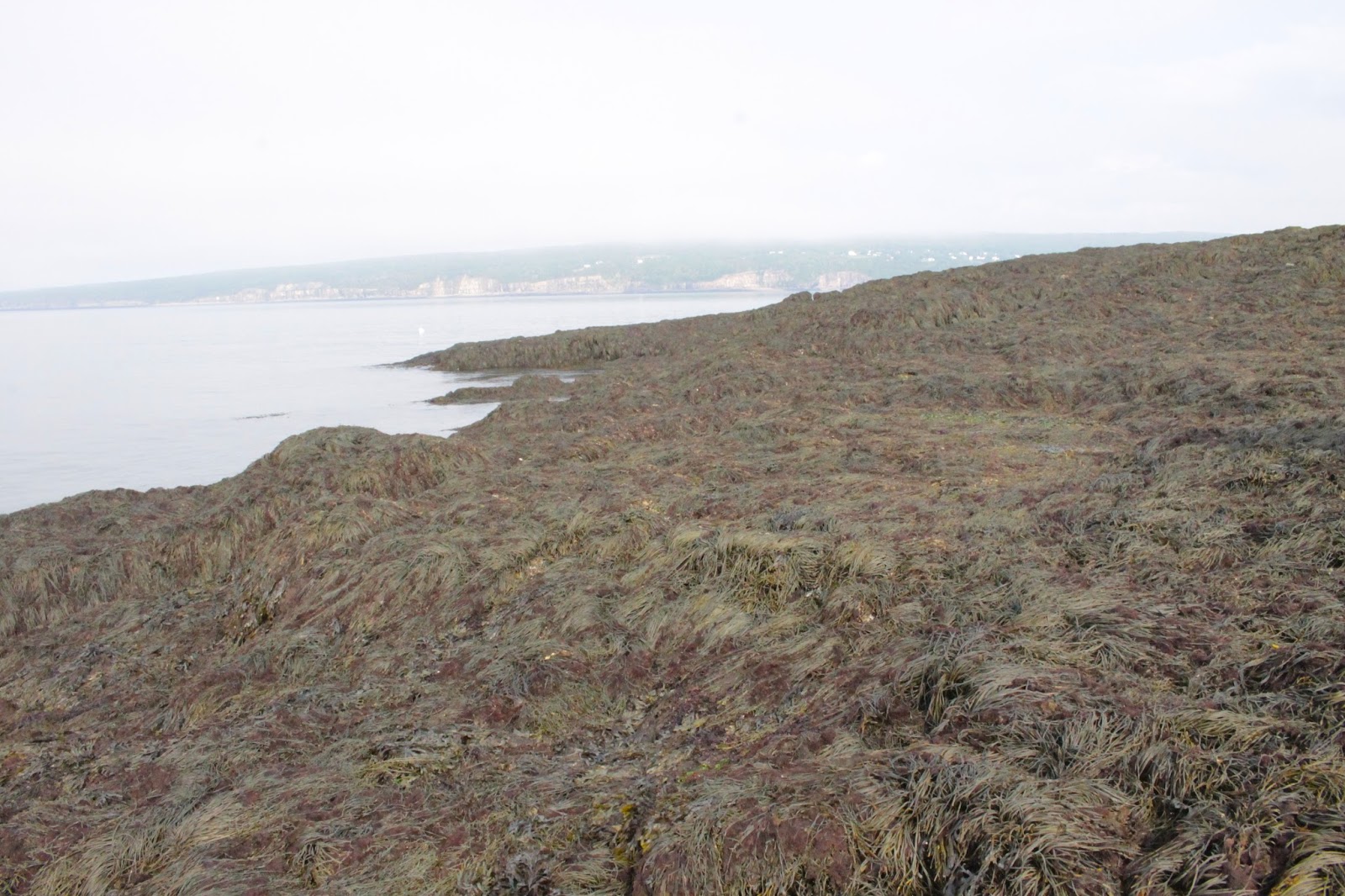
The tide had receded, yet some water remains.  It feels like we're on an alien planet.  What life is out there?


A beach plantain has found a tiny nook of soil between rocks.


Some of the water looks brown.  Is it the red oxide, or the lichen on the rocks?


We find a tidal pool, more like a tidal puddle, full of floating life.


We look at the seaweed's cell structure with round lenses we can hold over the water.  But our guide tells us to look for the even tinier...


Those black spots are creatures: Amphipods and more!  We don't have the magnification for plankton.


We examine other puddles, getting closer to the source of water.


What's this?  Periwinkles!  They are harvested as food by some.


We examine more red in the rocks and our first seaweeds.  These have air-filled bulges that help them float.


Periwinkles, seaweed, more amphipods...


A male crab hunting for tasty creatures!


We look in further.  Would we find the origins of our own species?


Further past the primordial ooze are a diverse array of seaweeds.  Peeling them back feels like we are the microscopic ones on a dog's back, looking for our friends amidst the fur.


And we find them!


We have now found three species of periwinkle.


And quite a few species of seaweed!


They look like tiny pickles!


Or chicken feet.


Actually, many of the seaweeds are edible.  We tried seaweed chips our guide had brought.  If you like kale chips, you'll love these!  Nova Scotians and Mainers also dry a blend of seaweeds as a seasoning called dulse.  Very yummy.  We got to see nori, which is used in making sushi rolls, and sea lettuce, which is delicious all by itself.  


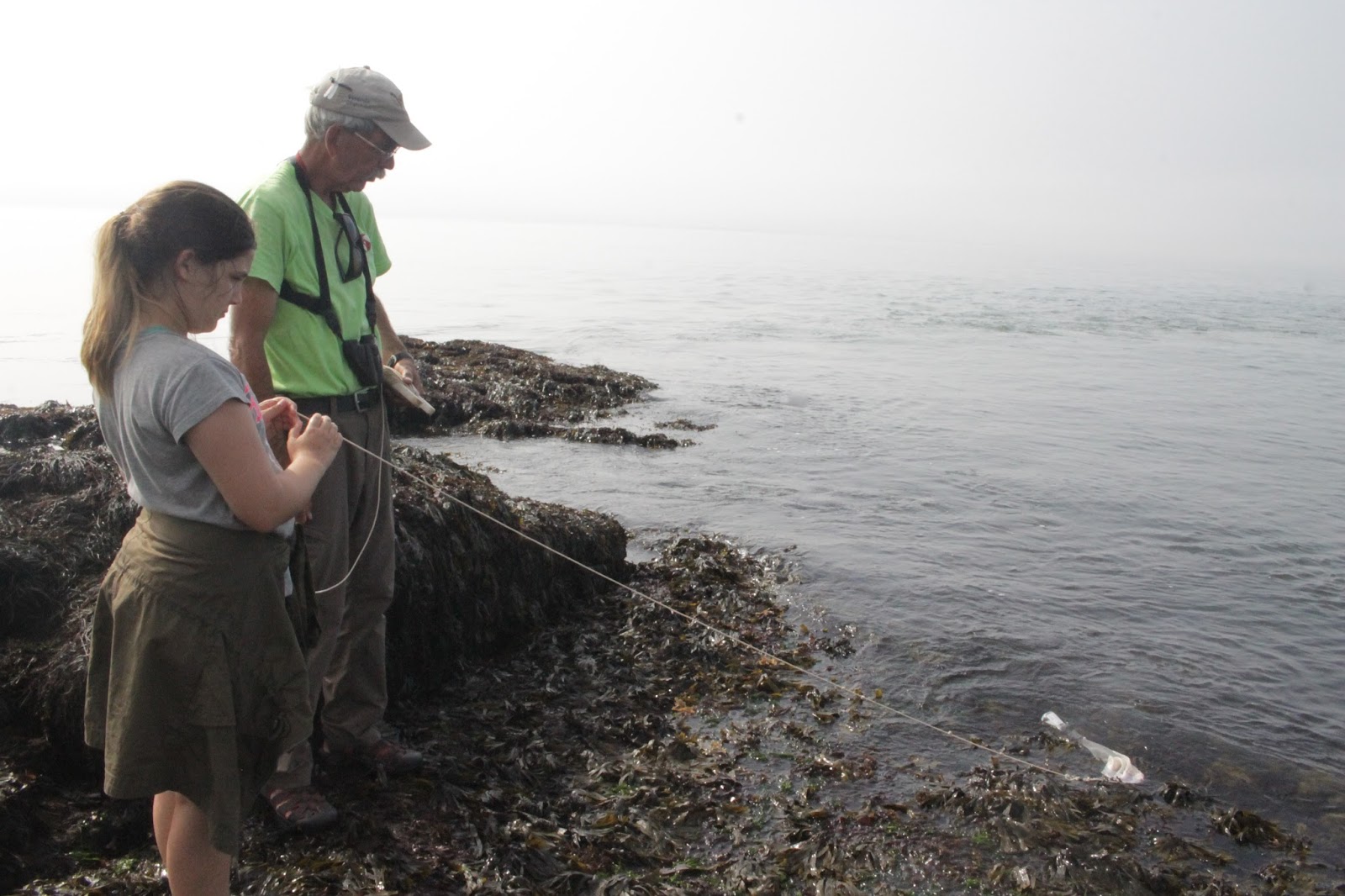
Next, we tapped into the source: A finely-netted basket was pulled through the sea water.


In that water were more amphipods, very active in our examining cup!


Here's a less common white periwinkle that was hiding beneath the seaweed.


The seaweed-looking creature below is actually the skeletalized remains of a bryozoan colony (Flustra foliace), which when you rub it smells like lemon!  Fishermen call it "lemon weed".  It is eaten by sea urchins and nudibranchs (sea slugs).  Other creatures such as sessile worms, the porcelain crab, even other Bryozoa can live on it as a substrate.  A colony might live for 12 years.


An interesting find:


Native scallop:


Can you guess what's on the right?


Here's the other side...


It's the smallest bone in the body.  An inner ear bone.  Of a humpback whale.

Here's a humpback whale from our Whale Watch in the Bay of Fundy:


Humpbacks do not have teeth, but baleen, which they use to sieve out hundreds of pounds of tiny plankton.  They'll chase the plankton into dense, huddled balls, then swallow them all up.  In an ecosystem, even the tiniest creature can have huge impacts on others higher on the food chain.  What affects the plankton (such as algal blooms mostly caused by fertilizer run-off or incompletely treated sewer water) can affect the many creatures that are part of its food web, including us.

Thank you Greg Turner and Gael Tours for all we learned about the tiny creatures of the tide pools, as well as helping us arrange a whale watch and trail walk across the bay.  The Bay of Fundy has the highest tides in the world.  We had explored the rocks and tide pools while the tide was low.  Looking back, water already covered where we had been...