Showing posts with label biodiversity. Show all posts

Monday, June 1, 2020

Be the Change


I can’t be at rallies or protests for a number of reasons. I’ve had pneumonia this time of year and have an auto-immune disorder. If I get arrested, I can say good-bye to my teaching career. I have a child that needs me. But I still want to do what I can to advocate for and protect those I love. This is just one action I am am taking in response to these times:
I teach about the environment through art. I teach about the importance, the necessity, of biodiversity. Children thrill at the diversity of colors and shapes and textures in leaves, in seeds. I teach about pollination, not just about the introduced domesticated honey bees, but the solitary bees, the butterflies and moths, the beetles, flies, ants, birds, and even bats that pollinate. Without insect pollinators, humanity would be wiped out. We don’t get to decide which insects get to pollinate our tomatoes, which more often will be a bumblebee, nor should we. Using pesticides and enforcing monocultures is toxic. Words of hate and racism and suppression of other races and cultures is toxic.
Today I continue work bringing nature to children. I am mostly engaged online, but I prepare for the time we can be together again. I struggled with putting nature under a plastic shield, wanting kids to touch actual leaves and galls knowing some would be crushed. Now I seal some of my favorite pressed leaves under lamination so each child I teach can look at their diversity before collecting their own leaves around where we are. I will wipe all the sheets down with Lysol. I’m placing robin egg shells, cicada exoskeletons, dragonfly exuvia, and oak apple galls inside clear plastic cases to pass around and wipe between each student, as they learn how nature solves problems.
We need to change our nature as a society. Be the change you want to see.


We need to change our nature as a society.  Be the change you want to see.

Sunday, March 29, 2020

Preparing for a New Normal


As we all adjust to these rapid transitions, I wanted to let you know that you are not alone and there are even silver linings.  With the halt in industry and travel, CO2 emissions are down. Dolphins frolic in Italy. People are enjoying nature more. We've been forced to slow down.

Well, maybe after we learn how to navigate several new platforms, make dinner, and find new ways to live...  Take a deep breath.  Go outside.

In the next days and weeks, I'll be posting very easy and quick ways to live sustainably with little or no money. Some of this will be through repurposing materials, some will be gardening timelines and tips, some will be "mini vacations" around your neighborhood.  It's how I live.

So much of the American lifestyle generates waste at a systemic and institutional level.  The skills I will post here will help you live in a "closed loop", where nothing is wasted.  I hope you enjoy them.

Please leave a comment on what you'd like to learn, what you need.  Sign up for the email list so you know when I post.  There are many free resources at both sides of this page. Use them. Share them.  Learn a new recipe, an edible plant. Look to nature and how the earth solves problems and survives.

If you're able to make a donation, the button is on the right.  (If this post was shared, go to 15minutefieldtrips.blogspot.com.)


Wednesday, October 10, 2018

What Can Babies Tell Us?

How can babies tell us about their environment?  Recently, I visited three locations and collected macroinvertebrates (small and mostly immature insects still visible to the naked eye) from the ponds at Borders Farm in Foster, Buck Hill Wildlife Management Area in Pascoag, and Trustom Pond in Matunuck.  Different species have different pollution tolerances, so certain species would indicate how clean the water was.

Abstract art or animals?  Maybe water pennies?  Very tiny.

I first collected at Borders Farm, which has a small retainer pond with cattails, grasses, lily pads, algae, and lots of frogs.  I was there to run an insect workshop and in the past another collector found a number of insects as well as leeches.  I went into the shallow water with my rain boots and clean white plastic tubs, swishing my net back and forth through the fairly clear water.  It was teeming with water boatmen and I dumped every scoop into one of the tubs I had added pond water to.  I picked out the plants, swirling them one more time in the water and examining them before returning them to the pond.  I added clear pond water to the other tub and brought them both over to the table.    Then I waited for the sediment to settle.

Photographing these creatures posed its own challenges.    It was a sunny day and we were set up in the shade.  The sun was in my eyes most of the time, plus I was running a workshop.  But I did get a few shots of some of the creatures.  

Very pollution-tolerant are aquatic worms, blood worm midge larva, left-handed snails, and red-tailed maggots.  I'm sure I didn't find every species in that pond, but I saw all but the maggot larva.    

This snail looks like it's holding a balloon!

I didn't know to check which side the hole is on.  I think this is a left-handed
snail, which breathes air.  (Right -handed snails have gills.)

Backswimmer from the pond.  Shadow of my camera lens?  Fairly tolerant species.

Even another species?
Mysterious newcomer!  I later identified it as a phantom midge.

Next in tolerance are the midge larva, like the phantom midge above, planar (flatworms), black fly larva, and leeches.  Moderately intolerant to pollution are the damselfly nymphs, dragonfly nymphs, sowbug, crankily larvae, clams, and scuds or amphipods.  We found two dragonfly larva and a few scuds.  At the least tolerant tier are the stonefly and mayfly nymphs, riffle beetles (adult and nymph), caddisfly and dobsonfly larva, water penny larva, and the right-handed snail.  Below, see the mayfly nymph!

Mayfly nymph.


This was so exciting and I wanted to do it again with more time to improve the photography.  At Buck Hill, I repeated my collecting with my cleaned, bleached, and rinsed bins to have another look.  I moved the bins to a sunnier spot, still struggling against glare and shadows cast by either me or the sides of the bins.  But I got a few better photos and a few people interested in what I was doing, including an older couple walking their dog and a man from the USFS!  ("No, I wasn't with DEM.  I was just taking pictures before I let them go.  Do you know...")

Another oarman.

Dragonfly larva!


I did the usual sweep through the plants and dump.  With the many oarsmen at Borders, I was looking for movement.  But then I saw something big drop out...  What WAS this?  I saw the long projection and guessed water scorpion, my guides left at home.  And it was!

A water scorpion!  Not actually a scorpion, but a predatory insect
found in slow-moving water.  This guy did not move fast, so I easily
moved him to the clearer tub for the photo.
On to Trustom Pond, a much larger body of water with frogs and painted turtles.  There were oarsmen again, and my first leech!  It was on a turtle we caught and  stubbornly clung first to the turtle's shell, then to the boardwalk, then the tub.  (The turtle snapped the stick with its beak and hissed at us, but after a few quick photos, we let it go.)   Doing more sweeps, I brought up a lot of muck.  As I swished through it, we found many aquatic sowbug (isopods).  There were also dragonfly and mayfly larva.  All three locations were quite clean!

Blood midge.  Very tolerant.
A clam! Moderately intolerant.
Aquatic sowbug.

Eat dead plant matter.

Can indicate a recovering ecosystem.

Got a cool shadow with this backswimmer.
Still dealing with bin shadow.

A whirligig beetle.  Moderate pollution tolerance.  Just briefly out of water.
The LEECH!!!!


Basic rule of thumb is the cleaner the water, the more biodiversity you will see.  The air-breathing species are more tolerant because they don't breathe the water.  Gilled creatures are thus more sensitive.  Seeing a pollution-tolerant species does not mean the water is polluted unless that's all you find.  Here's a good guide: https://scioly.org/wiki/index.php/Water_Quality/Macroorganism_List

But I know you're wondering about that turtle...

"Hiss! Boo! Put me down!!!"

"I still don't like this!"
One more pic!

Back at home!
 If you'd like to schedule a workshop in RI, MA, or CT, message me in the comments or at 15minutefieldtrips @ gmail.com.  (Spaced to stop robots from messaging me, lol!) I also  cover other insects, birds, fish, turtles, seeds, plants, and composting.  See you outside!


Saturday, July 14, 2018

The Wisdom of Prudence


I just returned from Prudence Island, where I was part of T.O.T.E. (Teachers on the Estuary).  My mind is swimming with new information on the role estuaries play in the environment and the impact of global warming.  First, what is an estuary?  It's a semi-enclosed body of water that is connected to an ocean, mixing fresh and salt water.  Sea water is diluted by fresh water spilling out from land drainage, creating a brackish habitat for shellfish, birds, specialized grasses, and many other species. It acts as a filter for sediment, run-off, erosion, even absorbing contaminants, animal waste, fertilizer, and more.  In Rhode Island, this is Narragansett Bay, with "2,924 acres of salt marsh, 1,466 acres of beach, 582 acres of rocky shore, 569 acres of tidal flat, 656 acres of brackish/Phragmites marsh, 160 acres of salt shrub wetland, 100 acres of eelgrass beds, 46 acres of panne and pool, 43 acres of dune, 9 acres of oyster reef, and 3 acres of streambed habitats (Huber, 1999)".  (The largest estuary on the East Coast is the 64,000 square mile Chesapeake Bay in Maryland.)  NERRS (National Estuary Research Reserve Sentinel Site) monitors 29 reserves across almost every coastal state (but sadly Louisiana is not a part of it).  

What would I learn here?  I went exploring along T wharf, in the south part of the island. There I found soft sand, a plethora of slipper shells, and the washed up remains of crabs.


An empty clam shell spread its angel wings open, its ghost in some crab or bird.  Down the beach, I found a dead seagull.  So much in the fishes' debt, it would now repay it.


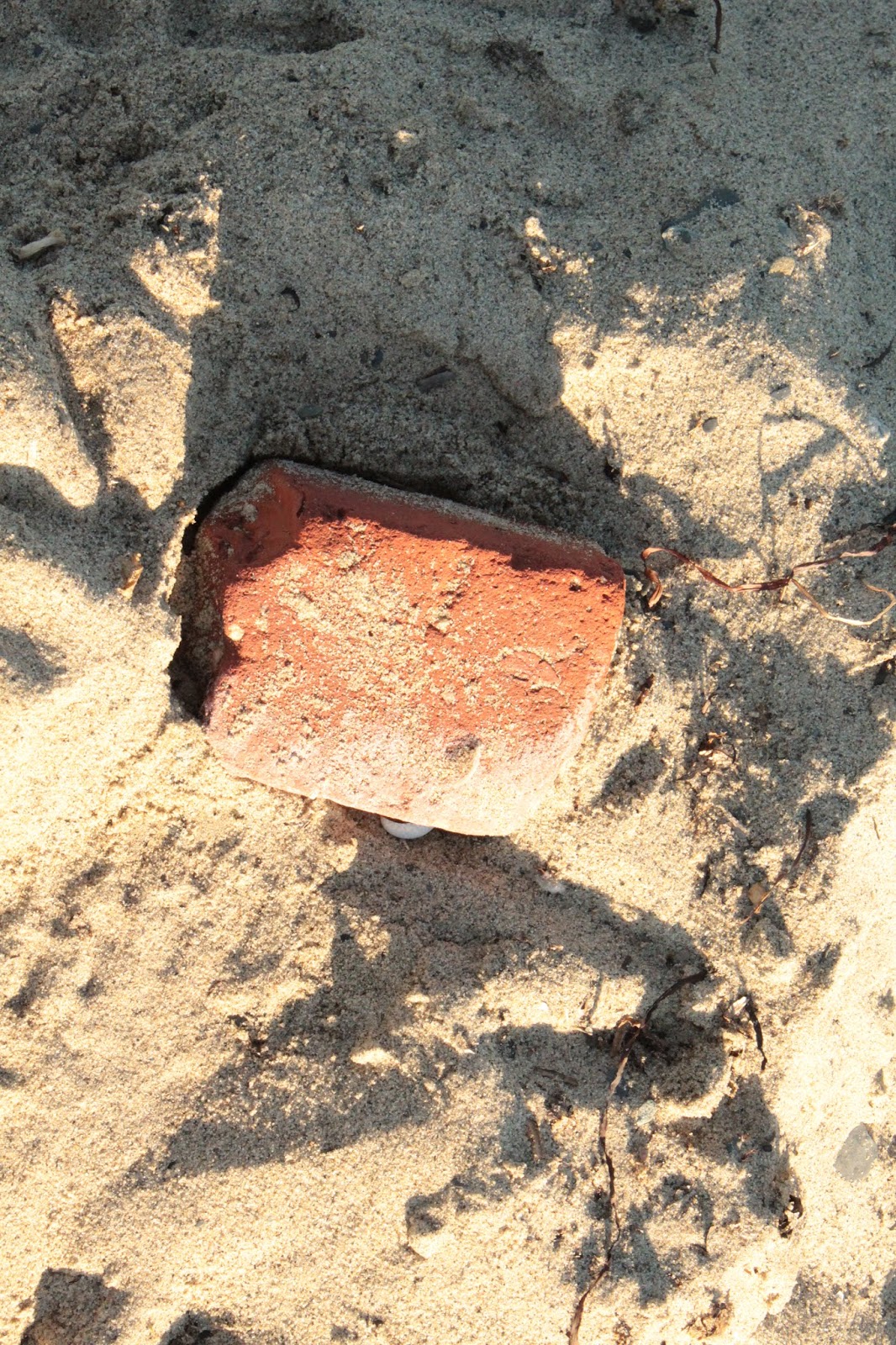
How many birds passed this way?  How long has this brick rolled in the surf?

Shy coffee bean snails stay moist above the salt.


How important is the estuary?  Besides its role as a filter, the tide brings in plankton and nutrients, the basis of the wetland food web.  There are more than 60 species of fish and shellfish in Narragansett Bay, bringing in $25 million alone.  Tourism, recreational fishing, and other recreational activities bring in $400 million annually, as well as create 15,000 seasonal jobs.  In addition, oysters can filter over 50 gallons a day and plankton can absorb river run off.  The estuary acts as a sieve, sifting sediment back and forth.  The resulting silt traps sediment and contaminants.  Estuaries also help with storm protection, buffering wind and water and fighting erosion.  But there is a limit to what the estuary can handle.  

Threats to the estuary include loss of habitat, such as when they are filled for building or transversed by roads.  Farm and fertilizer run-off, road run-off, land clearance leading to erosion, and sewage run-off can be excessive and create algal blooms, reducing dissolved oxygen in the water and killing wildlife.  People with land abutting wetlands should take care not to over-fertilize their lawns and to plant native wetland species along the water's edge as a buffer zone.  Non-native invasive species can quickly choke out native species, creating a monoculture that does not support the biodiversity of the species dependent on native plants and habitats.  

One such native species is eelgrass.  Eelgrass, one of the few seed-bearing plants that can tolerate complete submersion in brackish water, also provides habitat to fish such as shiners and North Atlantic puffer, shrimp, crabs, isopods, amphipods, bristle worms, shellfish, and the birds and other animals that eat them (including us).  Our group got to seine for specimens at the T Wharf beach and were not disappointed!

Seining the beach.

In this collection we found all of the above and a moon snail egg case!


A bristle worm, or clam worm.
It's hard to make out in the photo, but this one was giving off bioluminescence!

More about these Annelids here.

Hermit crabs were everywhere!
Two puffer fish were added to the exhibit tank.
Shiners!
We found two species of isopods.

Green crab and friends.
Whelk egg case.  Whelk shell.

Very feisty Lady crab!

We also got to witness how fiddler crabs change the environment, softening banks with their digging and getting the marsh to "migrate"!  Mussels were prevalent along the marsh creek.  


Mucky and just right for some invertebrates.

Small green crab from the creek.
Horseshoe crab in Nag Marsh creek.

Not a "crab", but its own Order of Arthropod.

Fossil records at the Visitor Center and exhibit.  Horseshoe crabs have changed
very little over the ages and are sometimes called "living fossils".

Dead horseshoe crab at the North End.
Slugs hiding under the living horseshoe crab.

Mussel bed.

Fiddlers scatter at our approach.


Hiding in the mud, waiting for food to go by.  Only the males have the larger claw.

Another green crab.

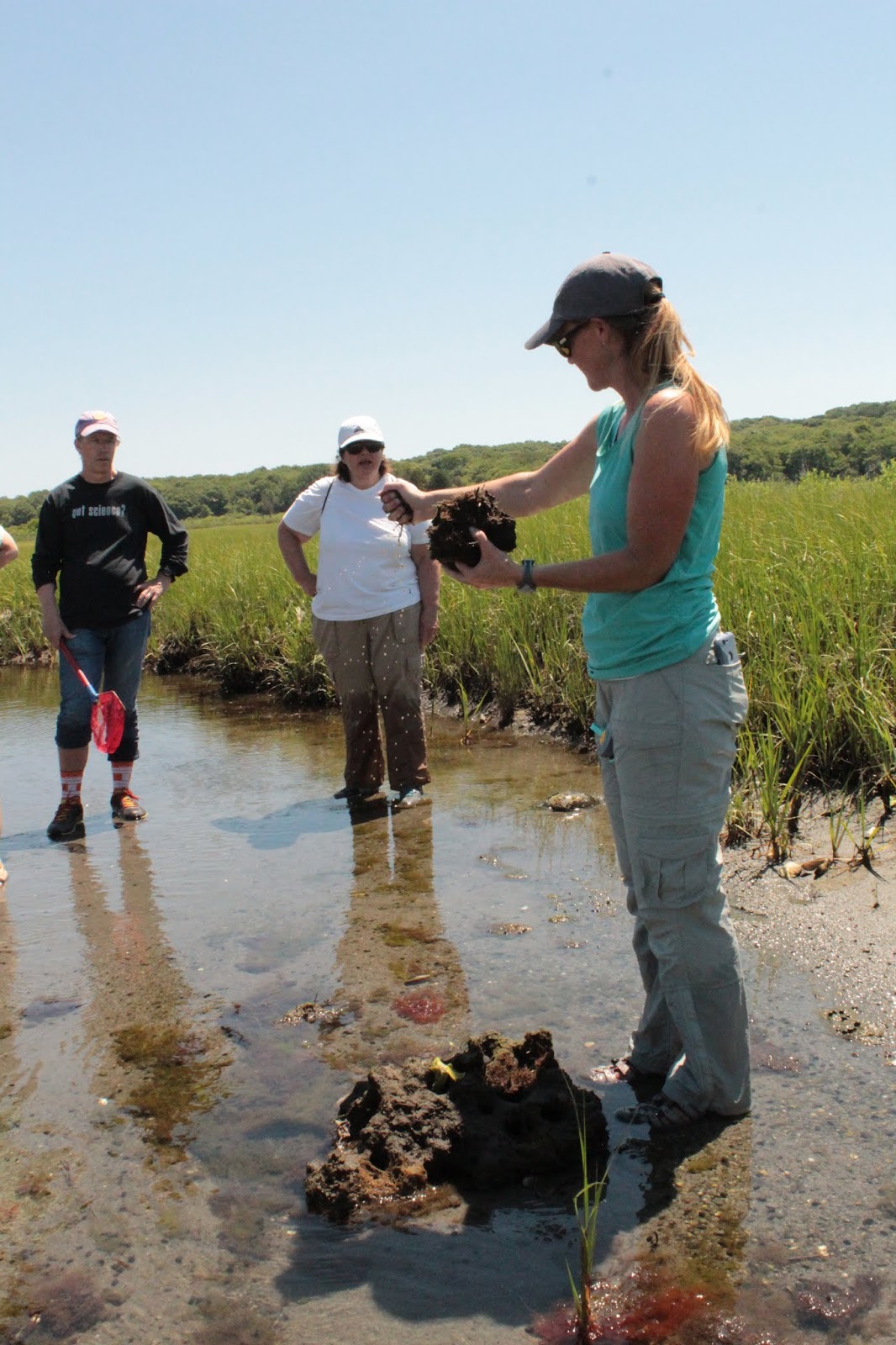
Clumps of peat allow grasses to grow.  Cord grass actually
 secretes salt to help it survive the brackish water!
Examining peat.


We monitored the biodiversity of the plants using a point intersection method.  Basically, we lay a yard stick down, and noting at the 0, 25, 50, 75, and 100 cm marks, we wrote down the species we observed, going down in a grid pattern until we had marked 50 points.  We mostly had salt meadow hay, some cord grass (which excretes salt to survive the brackish water) and spike grass, and a single marsh lavender (which is a forb).  Other areas had the tasty sea pickle.  At higher elevations, marsh elder shrubs took over.  

Cordgrass (L), Sea pickle (R).
Seed heads.
Marsh elder (Iva).

Nasty green head fly.

With rising sea levels due to global warming, water will become more saline and elevation of water will literally drown salt marshes.  Species die off.  The marsh migrates to higher ground if the space and light are there.  Trees die off from the saltier soil.    One way monitors are trying to combat rising sea levels is to add sediment to create a blank canvas for natives to return to.  It's in the experimental stages right now.  Prudence Island has two mixes going down 17 cm, containing sediment with feldspar and biochar.  They were put in an already drowning marsh in early spring of this year.  They marsh is losing 5.5 mm of elevation a year and only building 1.3 mm a year unaided.  So far, only cordgrass, which propagates itself through seeds and runners, has appeared in the sediment plugs.

Exploring Chase Way Beach.
Two sediment plugs at Sheep's Pen in the North End, where Roger
Williams and others grazed sheep once upon a time.


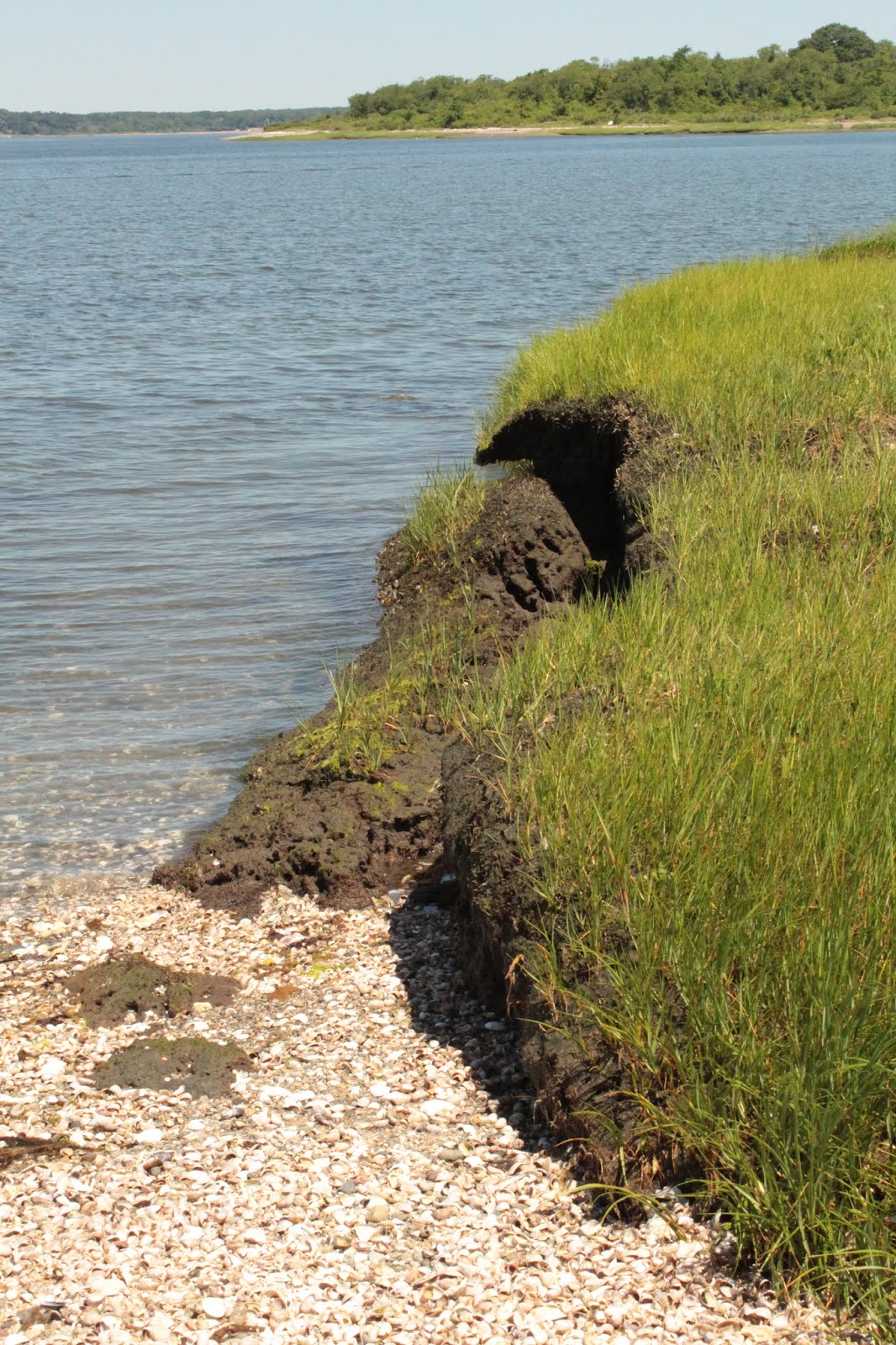
Up at Coggeshall Marsh, we saw erosion first-hand.  The soggy grass area was falling in and the dunes were eaten away.  Without the first buffer, much of the beach will disappear.  Current estimates show a sea level rise of over 8 feet by 2100.


Another threat to the shore are invasive species.  In an experiment, invasive Phragmites australis was removed along one edge of the beach and another swath left in place to compare the two.  The data from both the sediment plug experiments and phragmites removal experiments are shared with others with similar habitats to help make decisions on steps to take to preserve the marshes and estuaries.

Prickly pear cactus!

Prudence Island is unique in that some species thrive there.  (I even found a prickly pear!) But the island does have a number of invasive species, including the reed Phragmites australis, Oriental bittersweet, European larch, and barberry.  They also have Asian shore crabs, which range from North Carolina to Maine, perhaps even Nova Scotia.  (They first appeared in New Jersey in 1988 and can reproduce several times per year.)  They cross the Atlantic inside cargo ships that must take in water from their point of origin to balance their ship, then flush out that water after unloading to rebalance.  We had the task of monitoring number, size, and gender of these crabs by looking under rocks and trying not to get pinched!

Holding them on the side proved effective.  A "Washington monument"
shape beneath indicates male.  Females have a "White House" dome shape. 
Female.
Female with eggs.
Here, one is foaming to get oxygen.
An interesting reddish morph.  It may have recently molted.
They hide under rocks and avoid predation by seagulls.
This one liked me.

First, we used a 49 point grid using fishing line to note rock size:
sand, pebble, gravel, boulder.  Then we removed the smaller rocks first,
grabbing all the crabs hiding underneath.
We found many sizes, mostly male.


23 mm carapace.

Using a caliper to measure.  The smallest we measured were 2 mm.

Barnacles, another kind of arthropod, covered many rocks.

Amphipod and periwinkle snail.

Warming waters have brought predators to the native winter flounder, lobsters are moving further north into Canada, and black sea bass are moving into Rhode Island.  Maryland's blue crab may even start moving into New England states!  Below, bittersweet overtakes trees and poles.  Could kudzu be next?


There were signs of success, however.  An area once riddled with Phragmites australis now has cattails, cordgrass, and others moving back in after intensive removal of the reed.  

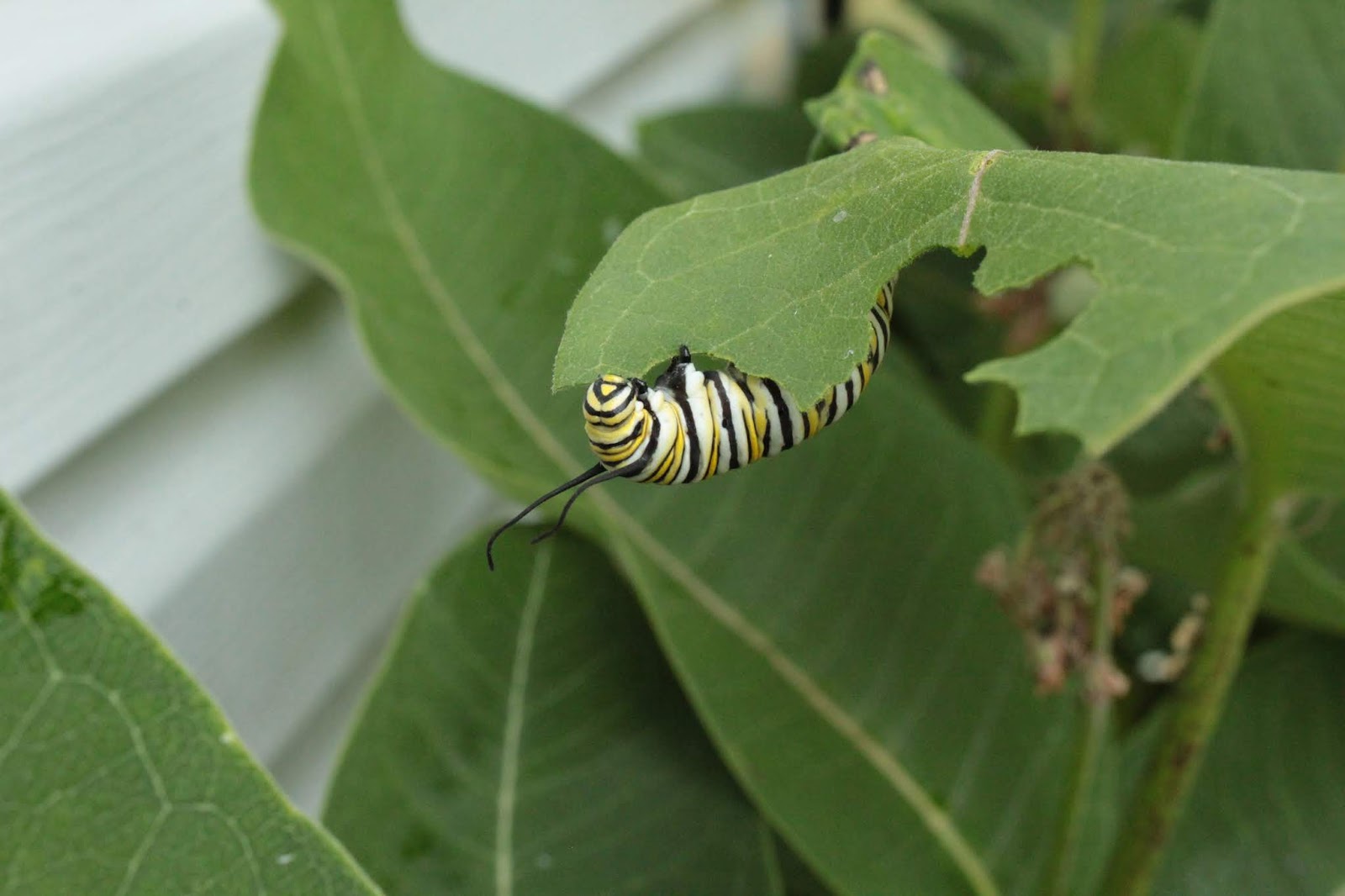
It is also a great area for pollinators!  There were plenty of copper butterflies, who especially liked the mountain mint in the pollinator garden.  I identified nine species of bees (Bombus impatiens, griseocollis, and perplexus, Apis mellifera, two Halictus, 2 Agapostemon, and a Ceratina.)  I watched two slow and fat Monarch caterpillars nibble away on milkweed.  Common milkweed is all over the island, but black swallowort (another invasive in the same family as milkweed, but toxic to Monarchs) has shown up too.


Copper butterfly.

Copper on mountain mint.

Agapostemon (Sweat bee).

Female ruby throated hummingbird.


Bombus perplexus.


Ladybug larva.

Spotless ladybug.

Milkweed borer beetle,

Bizarre growth?!!!
Aphids!

Munching Monarch caterpillar.


Need to identify this one.
Paper wasps.


Cross-section of found nest.


The Visitor Center is definitely worth a look.  There are taxidermy animals from animals found deceased, a kid nook with games, books, and activities, explorer bags, t-shorts, fossil remains, nests, and two bathroom!
Snipe.
Snowy owl.

Harrier hawk.

Turtle skeleton.  The island has nesting
diamond-back terrapins, an endangered species.

Meanwhile, a much alive osprey hunts for fish for her young...


Next blogs: Pitch pine and controlled burning, bird watching, testing the water, and more!