Showing posts with label environmental education. Show all posts

Monday, June 1, 2020

Be the Change


I can’t be at rallies or protests for a number of reasons. I’ve had pneumonia this time of year and have an auto-immune disorder. If I get arrested, I can say good-bye to my teaching career. I have a child that needs me. But I still want to do what I can to advocate for and protect those I love. This is just one action I am am taking in response to these times:
I teach about the environment through art. I teach about the importance, the necessity, of biodiversity. Children thrill at the diversity of colors and shapes and textures in leaves, in seeds. I teach about pollination, not just about the introduced domesticated honey bees, but the solitary bees, the butterflies and moths, the beetles, flies, ants, birds, and even bats that pollinate. Without insect pollinators, humanity would be wiped out. We don’t get to decide which insects get to pollinate our tomatoes, which more often will be a bumblebee, nor should we. Using pesticides and enforcing monocultures is toxic. Words of hate and racism and suppression of other races and cultures is toxic.
Today I continue work bringing nature to children. I am mostly engaged online, but I prepare for the time we can be together again. I struggled with putting nature under a plastic shield, wanting kids to touch actual leaves and galls knowing some would be crushed. Now I seal some of my favorite pressed leaves under lamination so each child I teach can look at their diversity before collecting their own leaves around where we are. I will wipe all the sheets down with Lysol. I’m placing robin egg shells, cicada exoskeletons, dragonfly exuvia, and oak apple galls inside clear plastic cases to pass around and wipe between each student, as they learn how nature solves problems.
We need to change our nature as a society. Be the change you want to see.


We need to change our nature as a society.  Be the change you want to see.

Friday, May 8, 2020

Sunday, April 5, 2020

Gifts


Need some environmental ed downloads? I just added two new ones, and everything is 20% off on Monday! https://www.teacherspayteachers.com/S…/15-Minute-Field-Trips

I hope you are all well.  I'm spending a lot of time on the computer teaching and preparing materials. I am grateful for my bird feeder just outside my window.  Today, we had blue jays, cardinals, downy woodpeckers, brown-headed cow birds, and junco, titmice, and nuthatch.  I hope the red-bellied woodpecker visits again!  Nature is a gift.

Sunday, March 29, 2020

Preparing for a New Normal


As we all adjust to these rapid transitions, I wanted to let you know that you are not alone and there are even silver linings.  With the halt in industry and travel, CO2 emissions are down. Dolphins frolic in Italy. People are enjoying nature more. We've been forced to slow down.

Well, maybe after we learn how to navigate several new platforms, make dinner, and find new ways to live...  Take a deep breath.  Go outside.

In the next days and weeks, I'll be posting very easy and quick ways to live sustainably with little or no money. Some of this will be through repurposing materials, some will be gardening timelines and tips, some will be "mini vacations" around your neighborhood.  It's how I live.

So much of the American lifestyle generates waste at a systemic and institutional level.  The skills I will post here will help you live in a "closed loop", where nothing is wasted.  I hope you enjoy them.

Please leave a comment on what you'd like to learn, what you need.  Sign up for the email list so you know when I post.  There are many free resources at both sides of this page. Use them. Share them.  Learn a new recipe, an edible plant. Look to nature and how the earth solves problems and survives.

If you're able to make a donation, the button is on the right.  (If this post was shared, go to 15minutefieldtrips.blogspot.com.)


Sunday, March 8, 2020

Food and Fun March 15th!


Do to several circumstances, we must cancel this event. If you are interested in learning more about our programs, email us at 15minutefieldtrips@gmail.com. Thanks for your support!!!

Want to learn more about what we do while enjoying great local food?  Join us March 15th, 7-9 at B.Good on Thayer St.  20% of your food order goes to 15 Minute Field trips to support environmental programming for youth. (Vegan and gluten-free available.) We'll have information, displays, games, and a 15 Minute Field Trip!  Reserve your spot by March 12!!!!

https://www.groupraise.com/events/139940?fbclid=IwAR3fmJ6D8IhMICM4KRnuGAtcde8MiixBSaPf77G2z_U3zkoZ7lEZmvVRAjo

Tuesday, February 25, 2020

February and March Events

We have lots of amazing events coming up! Wednesday, February 26th, I'll be giving a free talk on sustainable gardening at the First Unitarian Church in Providence 6:30-8.   https://www.facebook.com/events/2461937024121102/

March 7th 10-11:30 we're back at Blackstone Park to learn about frogs and toads by Irving Pond. https://www.blackstoneparksconservancy.org/events/frogs-toads/

Then I'll be doing a workshop on trees as part of the Land and Water Summit.  https://landandwaterpartnership.org/summit_register.php 

Session 3 Workshops: 2:45 am – 4:00 pm


Click on the name of the workshop to see a description of the workshop above the table.


3-B. Art for Environmental Advocacy

Melissa Guillet - 15 Minute Field Trips
Learn how to teach complex environmental concepts through art and engage the 
community in dialogue and action plans. Participate in a variety of art projects 
including song, dance, costume design, and drawing, and connect them to 
topics such as climate change, carbon sequestration, erosion control, and even 
fish migration! Leave with ideas to develop programs for your organization 
to engage families, partner with schools and youth groups, and more.

THE EVENT BELOW WILL BE RESCHEDULED:
There will be another free talk March 21st at the Cranston Library 2 p.m.


2:00 PM - 4:00 PM

Nature Systems in Your Backyard @ Central Nature is full of interlocking systems where nothing is wasted. Learn how to garden and landscape sustainably, how to attract more birds, butterflies, and pollinating bees, and how to create a welcoming habitat in your backyard.Presenter Melissa Guillet, Master Gardener, is an educator and expert on many topics including sustainable gardening, pollinators, and backyard habitats.This program is presented in collaboration with the URI Master Gardener Program and is the first of three sessions in our Spring Forward series. All events are free and open to the public.
CONTACT: Reference Department  401-943-9080 x3  central@cranstonlibrary.org
LOCATION: Central James T. Giles Community Room


April 4th we're at Blackstone Park to look under logs.  Then there's a kid's class on fish at the HeArtspot gallery 1-2:30.

See you outside!

Monday, December 3, 2018

15 Minute Field Guide Experiences

15 Minute Field Guide

A field guide is in the works!  Check out my Patreon page to get exclusive access before it's available to the masses!  Download individual pages here.  Get that perfect last-minute gift for a nature lover!


Friday, July 20, 2018

Free Stuff and Support

I'm running a FREE family activity at the Blackstone Park in Providence, RI, across from the boat house JULY 29th, where we'll be looking for evidence of animals from 1:30 to 3:00.  You can download the activity for $15 at my Teachers Pay Teachers site.

August 11th I'll be hosting "Bugemon Go!" and collecting and classifying insects at Borders Farm, Foster, RI.  Please contact them to register for 10-11 or 12-1 and check out their open house as well.

My Patreon is now LIVE!  Get first access to materials, videos, games, and more!

Environmental Education and Art

See you outside!

Melissa

Friday, May 25, 2018

When a Child Kills a Bee


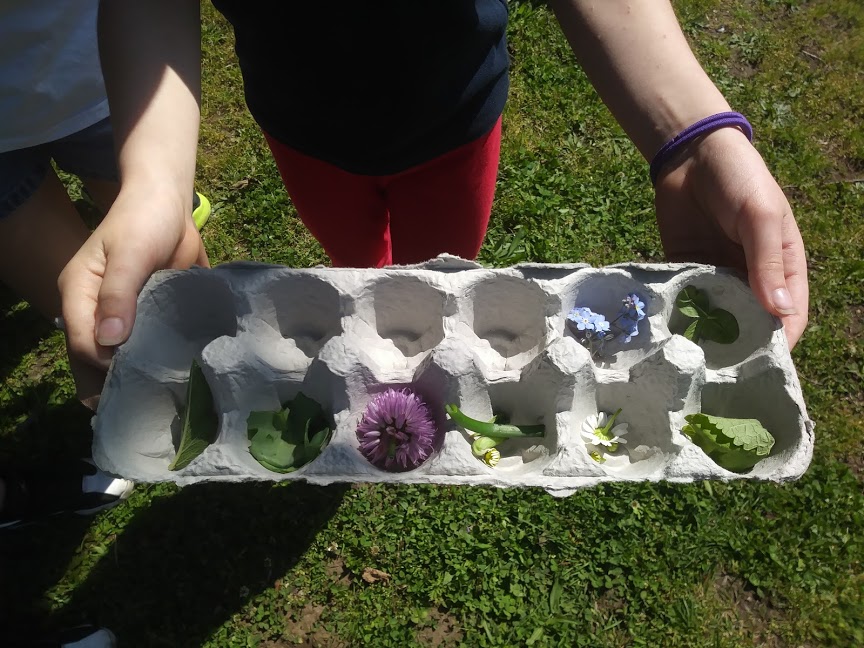
I was excited.  I had just learned several new activities in my School Garden Mentor course the previous evening and I wanted to try them out with my second graders.  I explained we would be playing 2 games outside and half-way-through, we would switch games.  Group A would do the egg carton activity first and group B the ant-eye view.

I started off explaining the egg carton activity where I had written two words on the bottom.  (Lesson plan here.)  I started with the trickiest: living and non-living.  We had touched on that concept months earlier when the students built a habitat for their beetle and they had to include sun, water, rocks, etc, with "air" implied.  Once they understood better, we discussed how those words related to each other.  Were they the same?  No?  What were they?  "Opposites", a student answered.  I also added you could call them antonyms.  

We looked at the words smooth and fuzzy and discussed what those adjectives meant.  They had given several examples of large objects for the previous word pair.  I demonstrated how they would look for objects to put in the egg carton that would actually fit in the egg carton.  They could pick leaves and flowers from the garden, but if it was a big leaf, maybe just take a piece.  We reviewed the other words (hard/soft, light/dark, moist/dry, scented/unscented), with me prompting them to give me the opposite of the first word I read.  I also demonstrated a Venn diagram with two hoops the kids would be free to use outside.


For the ant activity, we went over ant behaviors on a clip board.  They would work in partners (for both games), where the other partner would place the string on the ground and they both would follow the "trail".  They could do this multiple times and switch off placing the string each time.  The focus of the lesson was to get them better at observation.  They excitedly told me of many actual ants they saw during both activities, walking, climbing, and carrying things.


We reviewed expectations for the hall (walking quietly) and outside (stay in the fence area) and made our way outside.  I had kids compare data with each other and we switched activities halfway through.  The activities were very quick, and I wrapped it up quickly so we could go inside and share our findings.  Most students worked well together.  One I worked with alone.  Two others I gave special assignments to.  A student who regularly misuses materials I put in charge of carrying the big crate.  Then a student purposely stepped on a bee...

I got the line together, prompting and waiting for quiet before we went in.  I told them we'd go right to the rug to share.  The student who stepped on the bee I had talked to outside about being kind to animals and he wanted to share it with the class.  

We got to the rug and started by sharing about our cartons.  The kids had many observations and stories about what they had seen just then or at home.  My student who had killed the bee wanted to share, so I let him tell his story.  We talked about how we can better understand something we might be afraid of.  Kids suggested asking an adult or looking in a book.  The student suggested catching the insect and observing it.  I told them they were all good choices.

I was upset when this student killed the bee.  But I also knew it was out of fear and ignorance, and rather be angry with him, it could be a teachable moment.  To the untrained eye, every bee is a wasp and every three-leafed plant poison ivy.  It's up to environmental educators, teachers, and others "in the know" to educate others.  

For our third grade field trip two weeks  ago, I sent home safety tips about ticks and poison ivy (wear long pants and check your child at home) out of an abundance of caution.  One parent kept her child home.  No one who attended the field trip got hurt, bitten, or poison ivy.  (One child had a slight heat rash.)  That parent had every right to keep her child home, but I'm sorry she missed the experience.  You won't reach every person every time.  

The bee that had perished had been a leaf-cutter bee.  I told them it cut leaves with its mandibles (it had a tongue for nectar), but didn't eat the leaf.  We brain-stormed what that leaf might be for.  I reminded them of the carder bee that lines its nest with plant fibers.  The leaf-cutter uses leaves to build its nest for its eggs.

That morning, we had done observational contour drawings of our hands.  Last week, we had designed playing cards featuring bees.  I told them we'd be putting a sign in the garden to tell them all about bees, featuring their artwork.  Their hands could change people's views.  They could protect animals.

I'm hoping this lesson taught them not only to become better scientific observers, but also to ask questions about what they don't understand.  We live in a society that is increasingly diverse.  I struggle myself not with accepting diversity, but with understanding people better from his/her/their  point of view.  I ask questions to see if I've got it right.  I don't always do, but I am open to learning.

Five years ago, when my daughter was six years old, we went to a protest to protect the bees.  She explained "communication" to me: "It's like when a bee goes 'buzz' and another bee goes 'buzz' 'cuz they want to race up the mountain or something."  A hive of people marched, supporting real food and protecting the environment and the bees. One 9 year old boy was hoarse keeping up the chant and holding up his huge sign, keeping the adults going.  The work continues...


Learning to Kill


Surprised cry as she steps
across the deck, I rushing
to soothe and seek the cause.

Both barefoot, I find
no pebble, no splinter, but 
bending down, a bee
bent like a staple, severed
abdomen pulsing in her arch.

I worry allergies and shock
to a two-year old easily pacified.
But when I show her the bee
and explain what he did,
her happy-go-lucky ways go
homicidal.

With the toy she was chasing,
she pummels the dying creature,
fist tight with wrath.
“Okay, it’s dead,” I assure her, or
myself, or perhaps mostly,
the bee.

I lift her in flight
to the bathroom, a wet cloth and tweezers.
The abdomen falls away easily
but the stinger persists.

She doesn’t trust my explanation, 
so I demonstrate, pulling
a hair from the mole on my arm.
Assured, in seconds
the stinger is out.

I bathe my daughter
in kind words, warm water 
soothing the pierced skin,
hide my discomfort
my daughter has learned 

to kill. 

I wrote this about my daughter's first experience with a bee.  Then we learned to catch them with containers to watch before we release them .  Once, she found a bumble bee exhausted on the ground and picked it up with her hands.  It pinched her with its mandibles.  She didn't blame the bee.


Tuesday, August 15, 2017

Tide Pools: Bay of Fundy

It was a Facebook ad I clicked on that lead me here, with promises of whales, tidal pools, and magnifying lenses.  I was going to a foreign country to look at periwinkles and plankton!


One of my favorite wildflowers is goldenrod.  Contrary to popular belief, it's not goldenrod that causes allergies, but ragweed, in bloom around the same time.  Ragweed is wind-pollinated, so pollen is air-borne.  Goldenrod is insect-pollinated, so pollen is carried from plant to plant by insects such as the unique bumble bees I saw here.  Below is the seaside or salt marsh goldenrod, adapted to salty, course soils.  It would be the end of soil for a while...


We followed our guide Greg Turner (info@GaelTours.ca) further to the rocks below.  We had learned about the basalt and volcanic rock across the bay when we visited Balancing Rock in Tiverton (Long Island), NS.  Now we looked closer.  The reddish-brown lines were red oxide, or iron rust.  There appearance was caused by a chemical reaction.  Over time, water and the red oxide could split boulders!


There was little to no soil here.  We needed lichen and a few 100,000 years.


Sometimes air pockets formed as the rocks cooled, leaving behind pock-mocks.


But the site was far from barren...


An inuksuk greets us atop of a formation further on.  Take nothing and leave nothing is the golden rule, but this marker made out of stones at hand tells that people were here, and perhaps trails or food are ahead.
More on Inuksuks here.


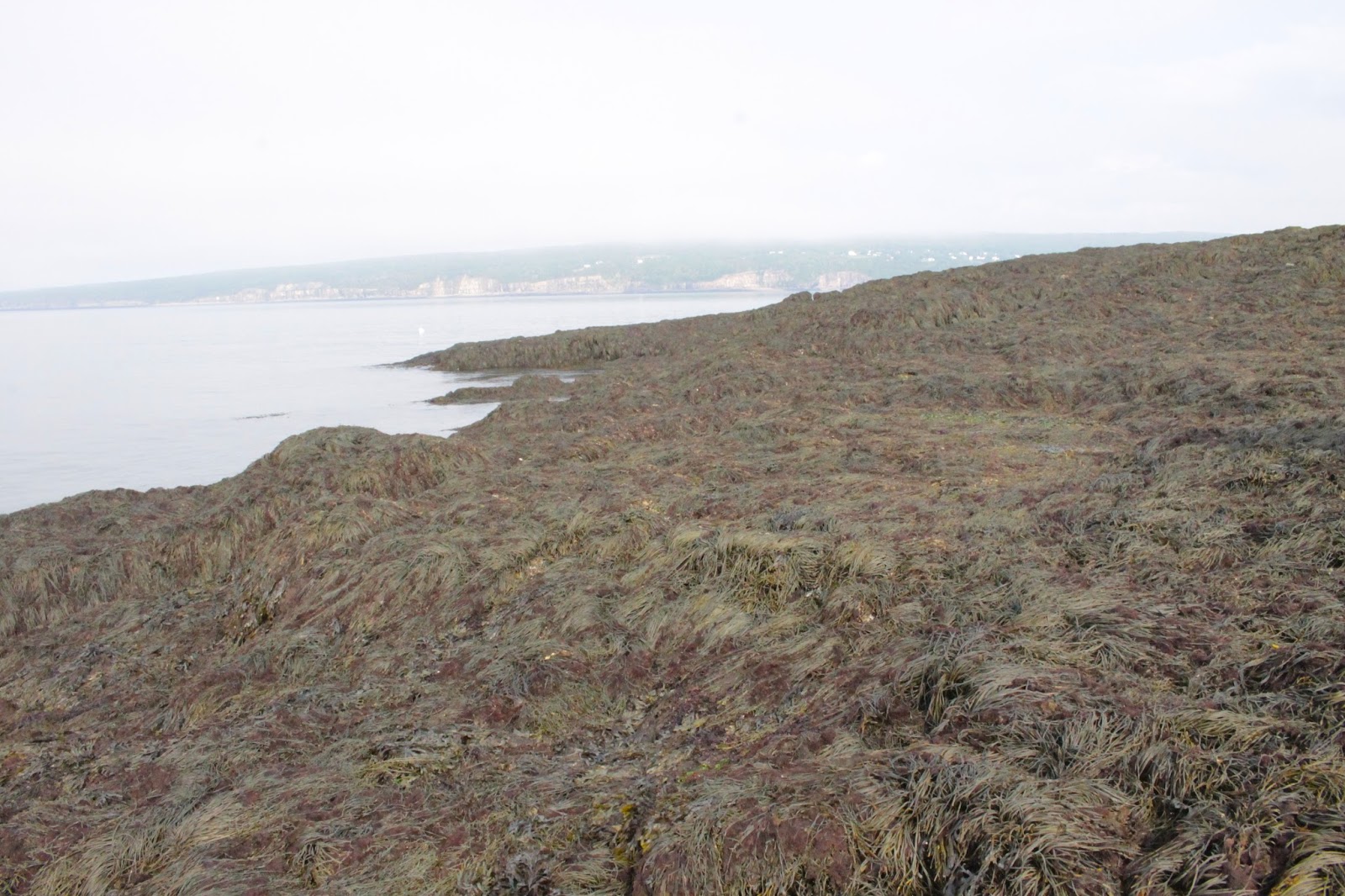
The tide had receded, yet some water remains.  It feels like we're on an alien planet.  What life is out there?


A beach plantain has found a tiny nook of soil between rocks.


Some of the water looks brown.  Is it the red oxide, or the lichen on the rocks?


We find a tidal pool, more like a tidal puddle, full of floating life.


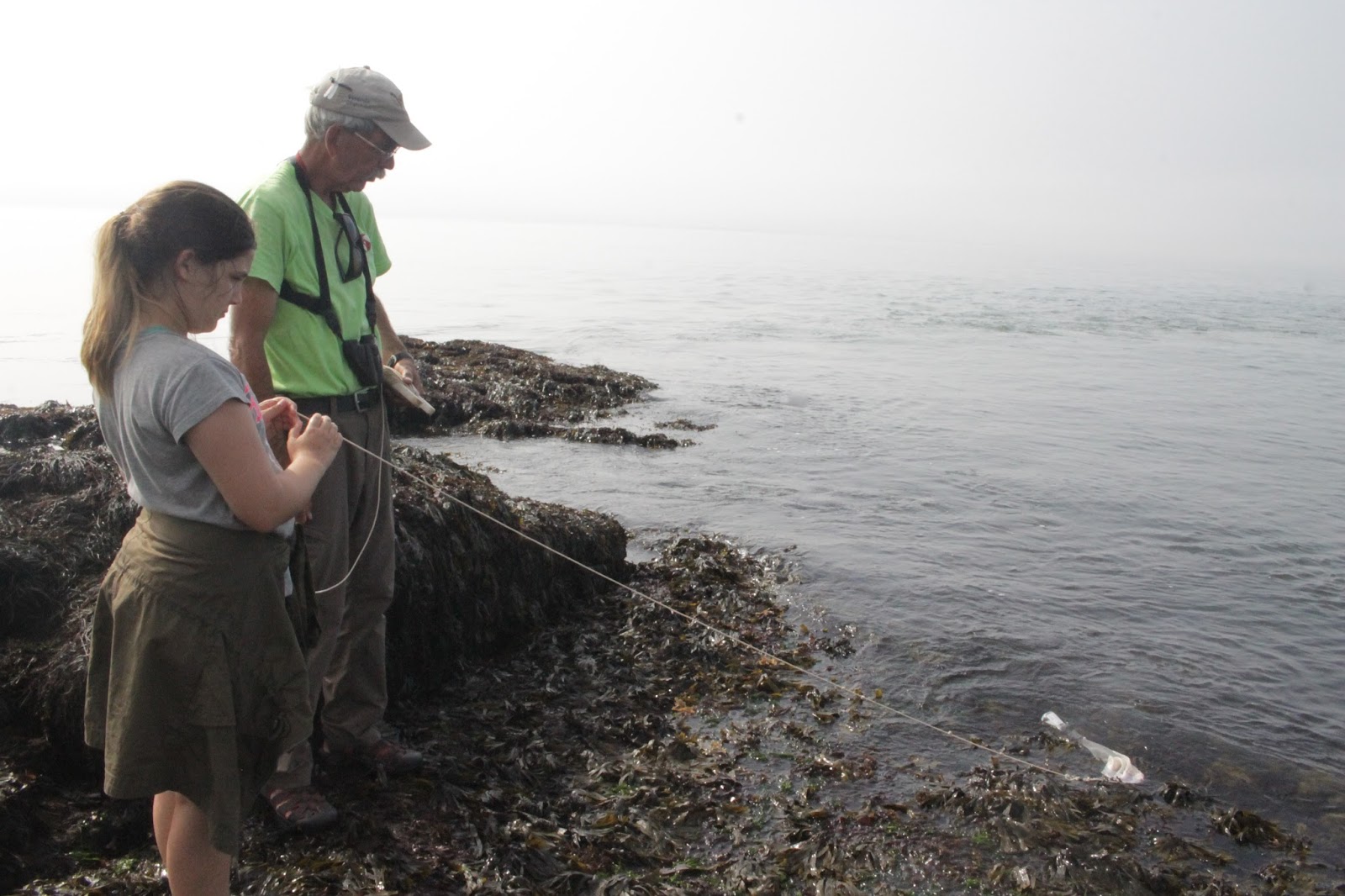
We look at the seaweed's cell structure with round lenses we can hold over the water.  But our guide tells us to look for the even tinier...


Those black spots are creatures: Amphipods and more!  We don't have the magnification for plankton.


We examine other puddles, getting closer to the source of water.


What's this?  Periwinkles!  They are harvested as food by some.


We examine more red in the rocks and our first seaweeds.  These have air-filled bulges that help them float.


Periwinkles, seaweed, more amphipods...


A male crab hunting for tasty creatures!


We look in further.  Would we find the origins of our own species?


Further past the primordial ooze are a diverse array of seaweeds.  Peeling them back feels like we are the microscopic ones on a dog's back, looking for our friends amidst the fur.


And we find them!


We have now found three species of periwinkle.


And quite a few species of seaweed!


They look like tiny pickles!


Or chicken feet.


Actually, many of the seaweeds are edible.  We tried seaweed chips our guide had brought.  If you like kale chips, you'll love these!  Nova Scotians and Mainers also dry a blend of seaweeds as a seasoning called dulse.  Very yummy.  We got to see nori, which is used in making sushi rolls, and sea lettuce, which is delicious all by itself.  


Next, we tapped into the source: A finely-netted basket was pulled through the sea water.


In that water were more amphipods, very active in our examining cup!


Here's a less common white periwinkle that was hiding beneath the seaweed.


The seaweed-looking creature below is actually the skeletalized remains of a bryozoan colony (Flustra foliace), which when you rub it smells like lemon!  Fishermen call it "lemon weed".  It is eaten by sea urchins and nudibranchs (sea slugs).  Other creatures such as sessile worms, the porcelain crab, even other Bryozoa can live on it as a substrate.  A colony might live for 12 years.


An interesting find:


Native scallop:


Can you guess what's on the right?


Here's the other side...


It's the smallest bone in the body.  An inner ear bone.  Of a humpback whale.

Here's a humpback whale from our Whale Watch in the Bay of Fundy:


Humpbacks do not have teeth, but baleen, which they use to sieve out hundreds of pounds of tiny plankton.  They'll chase the plankton into dense, huddled balls, then swallow them all up.  In an ecosystem, even the tiniest creature can have huge impacts on others higher on the food chain.  What affects the plankton (such as algal blooms mostly caused by fertilizer run-off or incompletely treated sewer water) can affect the many creatures that are part of its food web, including us.

Thank you Greg Turner and Gael Tours for all we learned about the tiny creatures of the tide pools, as well as helping us arrange a whale watch and trail walk across the bay.  The Bay of Fundy has the highest tides in the world.  We had explored the rocks and tide pools while the tide was low.  Looking back, water already covered where we had been...