Saturday, May 21, 2016

Looking Under Logs


It's magical, that hidden world.  Despite the broken glass, the dumped trash, the area we explored today, low in bio-diversity, still yielded surprising finds.  We wore long pants and treaded shoes.  We probably should have had long sleeves as well, especially when the mosquitoes by the polluted pond started biting.  We withdrew from the mayflies and skunk cabbage, avoided the sharp-thorned, invasive barberries and copious poison ivy, but were drawn in by lilies of the valley and other ephemerals, mysterious holes and seed pods hanging by caterpillar threads as if by magic.


Looking under logs, we found an enormous nightcrawler, several slugs - eggs accompanying one, pill bugs, tiny snails, beetles, centipedes, and amazingly, two tiny salamanders in very distant places.  They were much smaller than the one in our own yard, hundreds of feet away, and I wondered if it was because they were young or that our yard better supported such creatures.  


Last week, my daughter and I found the salamander, an over two foot garter snake, more worms, slugs, and snails, and a chipmunk all within an hour and in our own yard.  There are far fewer plant types in the supposed woods we explored, mostly swamp maple, oaks, a few types of pine, one type of fern, and lots of moss.  There's very little scrub or shrub.  There is trash everywhere.

Still, animals appear there, even if only to pass through.  I've seen swans and herons, deer and rabbit, fox and coyote, pass through or over my yard, a mere quarter acre on a busy street with two acres of trash-strewn woods, ball park, and vandalized cemetery behind me.  My own property continues to add layers, with more native plants added each year.  I've seen more bird species at the feeder, more hawks, including red-tailed and Cooper's hawk.  Last year, a goldfinch ate from my sunflowers and a hummingbird hovered before my face as I sat on my front steps just enjoying the garden.

Tomorrow, we visit the Garden in the Woods in Framingham, where inclusion and protection of native species is almost an art form.  It is biodiversity to dream about.


Looking under logs.
Pill bugs!


It's a log!


Worms and a termite.

Slugolicious!

Webbing and a dandelion seed?

Mysterious moss...or is it lichen?

Ground beetle!

Some kinda slime...

Frass and lichen.

Who's in here?

Can you see the salamander?

Look again!


One of many...

Slug eggs!!!

It tickles!


What's down here?


Invasive barberry.  Watch the thorns!

Roots grasp like fingers in the soil.


We wonder about holes and burrows...

...but we do not stick our hand in!

Mushrooms feast on dead wood.


Another salamander!

Tiny snail.

Firefly!


Time to fly home...


Wednesday, May 11, 2016

What's the Buzz?


There are over 4000 species of native North American bees.  The honey bee, European in origin, is not one of them.  Native species do not live in hives, and are not generally aggressive.  They are not protecting a queen.  They may live in holes in trees, wood piles, in holes they dig underground, maybe even the bee house made by us humans.  One in three bites of food in North America is pollinated by bees.  In Rhode Island, native plants such as blueberries, cranberries, squash, and melons are best pollinated by native bees rather than honey bees.  While honey bees provide many benefits, including the health benefits of honey and in combating allergies, there's much the non-bee-keeper can do to help our native pollinators thrive.

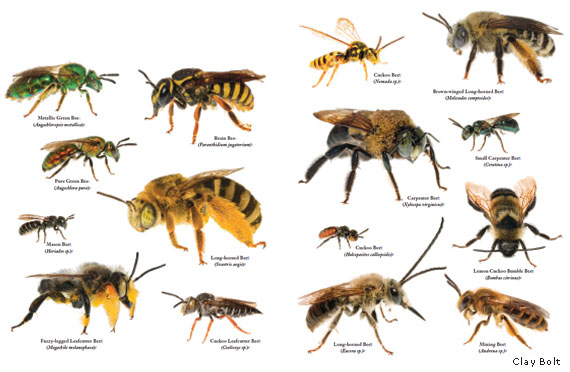
In recent years, populations have declined.  It's difficult to know how much, as study of native bees has been limited.  The Franklin bumblebee, one of several species of bumblebees, is believed to be extinct.  The rare rust patched bumblebee, however, has been sighted in areas it was believed it disappeared from.  Citizen Scientists can report sightings to BumbleBeeWatch.org.  This guide from Clay Bolt is a good place to start.


The best way to help pollinators of all types is to provide nectar sources from native plants early spring until late fall.  Early spring flowers include dandelion, ajuga, dead nettle, chickweed, clovers, common or false strawberry, pear and apple trees.  Late spring will be azaleas, blueberries, cranberries, and many crops.  Drought-tolerant and native species such as echinacea, liatris, milkweed, thistle, and more keep nectar going through the hot summers.  Herbs left to flower are well-liked by bees in my yard, especially borage, oregano, lavender, and thyme, transitioning late summer into fall.  Sedums, goldenrod, and aster take over then, fattening up bees for the winter months of hibernation.

Other plants to consider are snakeroot/bugbane, long-headed windflower, red columbine, many milkweed species, yellow wild indigo, pink cordydalis, northern crane's bill and other geraniums,  purple-headed sneezeweed, sunflowers, lobelia, lupine, evening primrose, golden groundsel, and our state flower, the violet.  Most of these are Rhody Natives, full-sun, and drought tolerant, and all are perennial, so they will be cost-effective in not needing to be replaced each year, not require much water once established, and be disease-resistant due to their natural adaptation to our area.  Fine-tune your own list here to select for color, height, etc.

Get a FREE assessment on how pollinator-friendly your yard is by signing up with https://www.greatsunflower.org and entering data about your site.  I scored 186/210 with recommendations to include native bunch grasses and clean out my bee nesting block.  Join their challenge as a Citizen Scientist by growing lemon queen sunflowers and tracking your visitors.

Here's a great place to get untreated seeds to grow pollinator favorites here.

Check out the April/May 2016 articles at the National Wildlife' Federation's site.
URI's Garden Resource site.
Build a Bee Condo

Coming soon: Build a Bug Condo and Creating Habitats Along Highways.

Tuesday, April 19, 2016

Fairy Days and Magical Moss Microworlds


Come visit the Botanical Center this month for Fairy Days! I'll be there today and Wednesday to show the magical micro worlds of moss! (I might even be wearing wings! ;p)  


Saturday, April 2, 2016

Learning Opportunities!


April 22nd is Earth Day.  Learn how to be more sustainable through these workshops and events!  Most are FREE:

Here's where you'll find me:

April 18th: I am giving a FREE talk on Insects at the Harmony Library at 6:00.  There will be bugs!!!
April 19th 9-1 and April 20th 1-4: I'll be dressed as a fairy and teaching about microfauna if you stop at the moss table at the Roger Williams Botanical Center in Providence.  Fairy Days runs April 14th to May 1st, select days.  More info here.
April 21st: I'm at the Jamestown Library 6:30-7:30 for a free talk on how to create a Backyard Habitat.
April 22nd: My favorite and four years running...Dirt and Detrivores at the RWP Zoo 11-3.  Meet pill bugs, sow bugs, earth worms, millipedes, bess beetles, and more.  Play "Dirt", the Candyland-inspired board game for worms.  Learn about compost.  draw an underground map.  Designed for kids, but adults welcome too!

Check out my article on Sustainable Eating Practices in the April issue of Natural Awakenings.

More events:

Master Gardener Talks: https://www.providenceri.com/botanical-center/calendar
Clean-Ups: https://www.providenceri.com/parks-and-rec/calendar
Nature/Science Stuff: https://www.providenceri.com/museum/calendar


Friday, March 25, 2016

Get the Dirt on Your Dirt! FREE Soil Testing

These are the soil testing events URI Master Gardener Association has so far this year. They will test PH and soil texture.  For contaminants like lead and cadmium, send samples to UMass Amherst.

4/2 Home Depot - 878 West Main Rd., Middletown RI - 10:00 to 2:00 - Roger Jadosz
4/2 Roger Williams Botanical Center, Providence RI - 11:00 am to 2:00 pm -  Charlie Junod, Phil Green, Bill Baddeley
4/3 Prescott Farm - 2009 W. Main Rd., Middletown RI - 9:00 - 11:00
4/9 Casey Farm - 2325 Boston Neck Rd., No. Kingstown RI - 8:00 - 12:30
4/9 Home Depot - 371 Putnam Pike, Smithfield - 10:00 to 2:00 - Roger Jadosz
4/9 Mount  Hope Farm, 250 Metacom Ave., Bristol, RI 02809, 9:00 to 12:00, Garry  Holmstrom  
4/10 Prescott Farm - 2009 W. Main Rd., Middletown RI - 9:00 - 11:00
4/16 Cranston Public Library - 1825 Broad St., Cranston - 2:00 to 5:00 - Bill Baddeley
4/17 Prescott Farm - 2009 W. Main Rd., Middletown RI - 9:00 - 11:00
4/24 Wildwood Nursery - Frenchtown Rd., East Greenwich RI - 10:00 - 2:00 -
4/24 Prescott Farm - 2009 W. Main Rd., Middletown RI - 9:00 - 11:00
4/30 Cranesbill Nursery - 30 New Meadow Rd., Swansea MA - 10:00 - 2:00 -
4/30 Hattoys Nursery - Coventry, RI - 10:00 - 2:00 - 
5/1 Hattoys Nursery - Coventry, RI - 10:00 - 2:00 -
5/1 Prescott Farm - 2009 W. Main Rd., Middletown RI - 9:00 - 11:00
5/7 North Stonington Garden Club - 311 Norwich-Westerly Rd., No. Stonington CT - 9:00 to 1:00 - Corliss Merkle
5/7 Smith Castle - 55 Richard Smith Drive, No. Kingstown RI - 12:00-  4:00
5/7 Scituate Library - 606 West Greenville Rd., N. Scituate - 9:00 to 12:00 - 
5/7 Roger Williams Botanical Center, Providence RI - 11:00 am to 2:00 pm -  Charlie Junod, Phil Green, Bill Baddeley
5/8 Prescott Farm - 2009 W. Main Rd., Middletown RI - 9:00 - 11:00
5/14 Casey Farm - 2325 Boston Neck Rd., No. Kingstown RI - 8:00 - 12:30
5/14 Mount  Hope Farm, 250 Metacom Ave., Bristol, RI 02809, 9:00 to 12:00, Garry  Holmstrom 
5/14 East Farm - Route 108, Kingston RI - 10:00 am to noon - Roger Jadosz
5/15 Mapleville Farm - 544 Victory St., Mapleville (Burriville) - 11:00 to 4:00 - 
5/15 Prescott Farm - 2009 W. Main Rd., Middletown RI - 9:00 - 11:00
5/21 Cumberland Monastery - 1464 Diamond Hill Rd., Cumberland RI - 9:00 - 11:00 - Ken Oles
5/21 East Farm - Route 108, Kingston RI - 10:00 am to noon - Roger Jadosz
5/22 Prescott Farm - 2009 W. Main Rd., Middletown RI - 9:00 - 11:00
5/28 Block Island Spring Festival - Block Island Library - 10:00 - 2:00
5/28 East Farm - Route 108, Kingston RI - 10:00 am to noon - Roger Jadosz
5/29 Prescott Farm - 2009 W. Main Rd., Middletown RI - 9:00 - 11:00
6/4 East Farm - Route 108, Kingston RI - 10:00 am to noon - Roger Jadosz
6/4 Roger Williams Botanical Center, Providence RI - 11:00 am to 2:00 pm -  Charlie Junod, Phil Green, Bill Baddeley
6/5 Prescott Farm - 2009 W. Main Rd., Middletown RI - 9:00 - 11:00
6/11 Casey Farm - 2325 Boston Neck Rd., No. Kingstown RI - 8:00 - 12:30
6/11 Mount  Hope Farm, 250 Metacom Ave., Bristol, RI 02809, 9:00 to 12:00, Garry  Holmstrom
6/11 Wilcox Park, Westerly - 9:00 am to noon - Corliss Merkel
6/11 East Farm - Route 108, Kingston RI - 10:00 am to noon - Roger Jadosz
6/12 Prescott Farm - 2009 W. Main Rd., Middletown RI - 9:00 - 11:00
6/18 Hope St. Farmer’s Market, Lippitt Park, 1015 Hope St., Providence RI - 9:00 - 1:00 - Mitch Williams
6/18 Cumberland Monastery - 1464 Diamond Hill Rd., Cumberland RI - 9:00 - 11:00 - Ken Oles
6/18 East Farm - Route 108, Kingston RI - 10:00 am to noon - Roger Jadosz
6/19 Prescott Farm - 2009 W. Main Rd., Middletown RI - 9:00 - 11:00
6/25 East Farm - Route 108, Kingston RI - 10:00 am to noon - Roger Jadosz
6/26 Prescott Farm - 2009 W. Main Rd., Middletown RI - 9:00 - 11:00
7/3 Prescott Farm - 2009 W. Main Rd., Middletown RI - 9:00 - 11:00
7/9 Casey Farm - 2325 Boston Neck Rd., No. Kingstown RI - 8:00 - 12:30
7/9 Mount  Hope Farm, 250 Metacom Ave., Bristol, RI 02809, 9:00 to 12:00, Garry  Holmstrom 
7/9 Wilcox Park, Westerly. - 9:00 am to noon - Corliss Merkel
7/10 Prescott Farm - 2009 W. Main Rd., Middletown RI - 9:00 - 11:00
7/16 Cumberland Monastery - 1464 Diamond Hill Rd., Cumberland RI - 9:00 - 11:00 - Ken Oles
7/17 Prescott Farm - 2009 W. Main Rd., Middletown RI - 9:00 - 11:00
7/24 Prescott Farm - 2009 W. Main Rd., Middletown RI - 9:00 - 11:00
7/31 Prescott Farm - 2009 W. Main Rd., Middletown RI - 9:00 - 11:00
8/7 Prescott Farm - 2009 W. Main Rd., Middletown RI - 9:00 - 11:00
8/13 Casey Farm - 2325 Boston Neck Rd., No. Kingstown RI - 8:00 - 12:30
8/13 Mount  Hope Farm, 250 Metacom Ave., Bristol, RI 02809, 9:00 to 12:00, Garry  Holmstrom
8/13 Wilcox Park, Westerly - 9:00 am to noon - Corliss Merkel
8/14 Prescott Farm - 2009 W. Main Rd., Middletown RI - 9:00 - 11:00
8/20 Cumberland Monastery - 1464 Diamond Hill Rd., Cumberland RI - 9:00 - 11:00 - Ken Oles
8/21 Prescott Farm - 2009 W. Main Rd., Middletown RI - 9:00 - 11:00
8/28 Prescott Farm - 2009 W. Main Rd., Middletown RI - 9:00 - 11:00
9/3 Roger Williams Botanical Center, Providence RI - 11:00 am to 2:00 pm -  Charlie Junod, Phil Green, Bill Baddeley
9/4 Prescott Farm - 2009 W. Main Rd., Middletown RI - 9:00 - 11:00
9/10 Casey Farm - 2325 Boston Neck Rd., No. Kingstown RI - 8:00 - 12:30
9/10 Mount  Hope Farm, 250 Metacom Ave., Bristol, RI 02809, 9:00 to 12:00, Garry  Holmstrom 
9/10 Wilcox Park, Westerly - 9:00 am to noon - Corliss Merkel
9/11 Prescott Farm - 2009 W. Main Rd., Middletown RI - 9:00 - 11:00
9/17 Cumberland Monastery - 1464 Diamond Hill Rd., Cumberland RI - 9:00 - 11:00 - Ken Oles
9/18 Prescott Farm - 2009 W. Main Rd., Middletown RI - 9:00 - 11:00
9/25 Prescott Farm - 2009 W. Main Rd., Middletown RI - 9:00 - 11:00
10/8 Casey Farm - 2325 Boston Neck Rd., No. Kingstown RI - 8:00 - 12:30
10/8 Wilcox Park, Westerly - 9:00 am to noon - Corliss Merkel

Saturday, March 19, 2016

Bunny Army


Snow in the forecast Sunday into Monday, so March's balmy lamb is going out with teeth and claw.  Yet, my lilac tentatively opens its leaves, the hyacinth bloom in the shelter of the spruce, the daffodil fill out their buds before bursting into lionine heads.  Chickweed and dead nettle flowers feed the early pollinators.  I leave them in the garden, except in the raised beds at school where we've planted beets and transplanted strawberries.  Snow or no snow, spring is coming!

Here's an annual favorite of mine.  I've been growing arugula and pea micro greens, which I will add to the "bunny bed" when I make this next week.  My two barred Plymouth Rocks are laying again, and I hope the white Araucana will bless us with her blue eggs.  

March 17th Rainbow


It's been a lot of things at once in my life, good and bad, at work and at home, and with friends.  I've been overwhelmed.  Yet, the sun shines and tomorrow and tomorrow and tomorrow comes.  I may put off planting today, but I will go outside.  Time is precious.  Every day should be lived alive.


Order my cookbook here.


Friday, March 4, 2016

Seed Saving

I'll admit it.  I have them everywhere.  Stuffed into the box my amaryllis bulbs came in.  In a reusable canvas bag.  In a padded manila envelope.  Then just yesterday, I discovered a huge bag in the back of my garage...

I need to organize my seeds!

February was a whirlwind of birthdays, time with my daughter, both of us sick at different times, art show preparations, scientific inquiry, and of course my regular "job".  I returned to work after a Family Sick Day taking care of my coughing little one, checking how the sub had left things and prepping for the day, squeezing in a meeting and morning duty before my first two classes.  When I went back to the office, I found I had received a package.  What is this, I wondered?  I couldn't remember ordering anything except the wheat grass I just planted this evening in a clam-shell salad container as micro greens and a stream macro-invertebrate science kit generously funded by the Barrington Land Conservation Trust I happily dissected Wednesday that my third grade Eco-Warriors will use this April in collaboration with eighth graders visiting from a nearby school.  

I  brought the box back to my room.  I had 15 minutes before my next class arrived and I hastily cut a watermelon, pea pod, corn, and bean to show the kindergartners different foods that contained seeds that they would be cutting out and drawing seeds onto with crayon.  It was a shape lesson (circles, ovals, and semi-circles, with "bean" shapes the challenge of the week) and a science lesson (plants have different parts; which parts of the plant do we eat?).  I taught the brand-new lesson, tying in with the healthy foods theme for our district in March, which followed fruit and vegetable ABC squares done with textured paper the kids made, cut, and glued, making a food that went with their letter and with help, spelling it (art and literacy).  After lining them up and getting the room clean (again), I opened the package.


A seed sorting kit!  What???

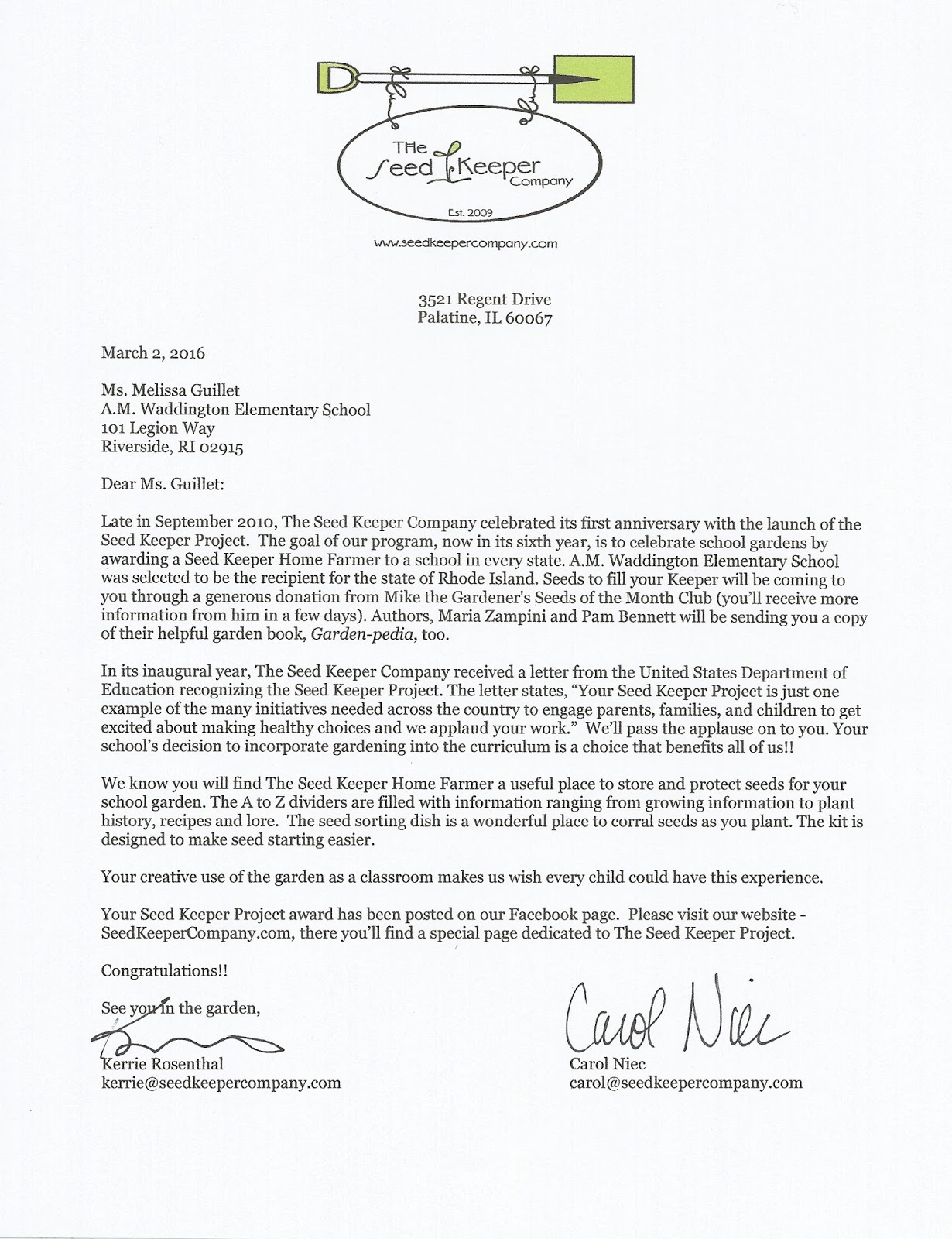
It came with this letter:


Wow.  Just wow.  I guess the word is getting out about what I'm doing.  I have more people visiting the school in the spring, one to write her thesis on school gardens including ours.  Last year, Whole Foods wrote an article about us.  Tomorrow, I'll be putting final edits on a piece for Natural Awakenings.  I recently joined RIEEA, and the resources and connections are multifold!  My mind is exploding with possibilities.  I need to breathe!  

I am so grateful, so overwhelmed by all the support!  I have many more exciting projects in the works.  


When those seeds get sorted, some will be too old to use.  I will sort some into plastic bins (found cheaply at Job Lot) for scientific study and art fun.  The first graders will be recreating Van Gogh's sunflowers and irises in collage, cutting circles, triangles, rectangles, and hearts, then folding or curling the petals and leaves for a 3-D effect.  They will also learn plant parts and glue some of those expired seeds inside their flowers.  Link to the lesson here.

Meanwhile, I have seeds to sort!

Update:


Finally sorted my seeds.  I had way too many to fit in there, but i think the average home grower should have enough room.  The velcro dividers are easy to move.  I turned some sections sideways to better fit.  They're in alphabetical order, so sunflowers are with squash.  With so many annual flowers of many names serving similar purposes, I just filed them under "flowers".  Overall, a nifty way to organize seeds for our school garden!  Thanks again, Seed Keeper Company!