Showing posts with label Snake Den. Show all posts

Sunday, June 11, 2017

We Will Not Be Silent Spring

I just had the most WONDERFUL experience of Bioblitz, where scientists, artists, and lay people get together to identify as many species as possible to record the biodiversity of a selected area.  This year it was at Snake Den State Park in Johnston, RI.  There were the usual teams: The "birders" who can identify birds by sight and sound, even if it's a mockingbird singing like a lark, the mammal crew, the moss seekers, the lichen table, the mushroom hunters, the creative writers, the artists, and more.  This year, I went to collect bees and help out with the litter bugs.  I did a bit of drawing and photography as well.

Walking down Brown Ave., I found a butterfly I had never seen.  I caught it with my net and took it back to identify.  It stayed on the cup long enough for me to get a picture.  Red-spotted purple.


Then, following the dragonfly team through the fields (in long pants, of course!), I found over a dozen of these guys chewing on the plantain.  I was told they used to be rare, until they diversified their food choices.  Baltimore butterfly.


The dragonfly team identifies another one!


The beetle guy always has such interesting finds, as beetles are such a diverse order.  I found this one near the base of a tree and a whirligig in one of the many small ponds.
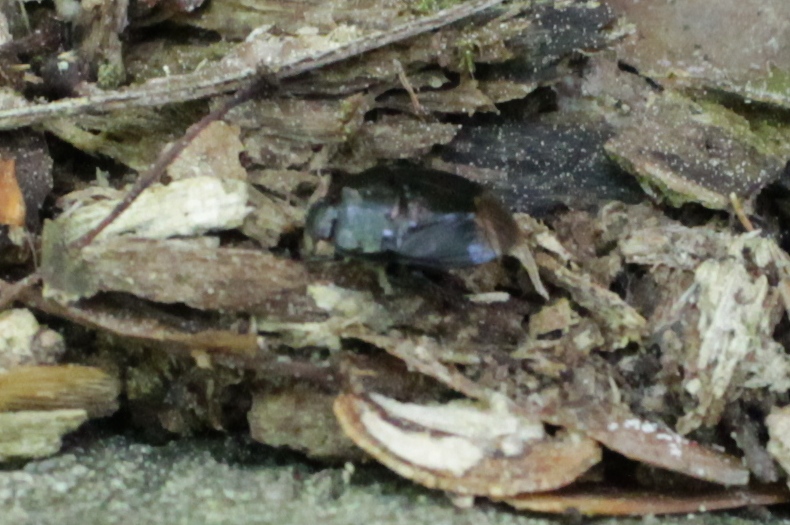


This is of course a spittle bug, one of the "true bugs" among many.


The many moths found at Snake Den:


And many ants as well.


No final numbers yet, of course.  I collected bees by hand and found six species, which I tentatively labeled as the genus Bombus impatiens, Bombus sp. 2, Ceratina, Perdita, Sphecodes, and Apis mellifera.  The ant collector found an Agapostemon, I believe.  Another person used "bee bowls", placing bowls with sugar water ever ten? feet for a 150 feet and found bees mostly different from mine.  Most appeared to be from Family Hyalictidae.  We went back and forth trying to identify them, comparing body proportions, abdomen and wing patterns, length of antenna.  I'm only fairly certain of the Ceratine because of it's size and white mark on its face.  It is a difficult task, and the specimens will be going to an entomologist at URI to identify species.


As always, there were amazing varieties of lichen, moss, and mushrooms:


Other unexpected finds were what must have been a 6 foot snake skin and a skeleton of what I was told was a fox.  One of the highlights for me was finally finding a tardigrade!  I found rotifers and nematodes as I often do.  But thanks to Leslie on the Litter Bug team, she found this little guy from a scraping I had taken off an oak tree:


Here's the video:


An more pics of this cutie!  Next time, I'll bring my microscopic camera and hope it works. 


It's a 24 hour experience.  Camping out, I walked to my tent under a full moon, adjusted my sleeping bag so I wasn't facing down-hill, and fell asleep in minutes.  Next year, I'm coming with friends!


Oh, one more thing.  I also collect data for Frog Watch.  Three years ago, all I heard from this man-made pond in an urban spot near 295 were spring peepers.  Last night, there were bull frogs, green frogs, and gray tree frogs.  They were not being quiet.


Thursday, June 8, 2017

Bioblitz 2017


I am very excited about participating in Bioblitz at the Snake Den in Johnston, RI this year!  I am part of the art team and will also be collecting bees for identification and looking for microscopic critters in moss.  Stay tuned...

Monday, September 19, 2016

I Went into the Snake Den and Came Out with...


Snake Den State Park: Do You Dare?

I did!  I went in.  I made discoveries.  I found...nature!

Snake Den State Park is a 1000 acres of woodland, field and historic running farm (Dame Farm) off Hartford Ave. in Johnston.  I started at the trailhead behind the fire station, enjoying the ferns and cooler temps below the trees in late August.

False Solomon's Seal with berries.
Green briar has thorns!


Bittersweet, also with berries.

A downed tree makes a magical hideaway.
Sassafras: The mitten/dinosaur track/football-leaved plant!
Autumn olive???
Them's poison ivy...
Quenn Anne's Lace going to seed. 
More sassafras!
Sassy all over!!!
Some day I will be able to identify ferns.  Did see some ostrich and sensitive fern.
The canopy...


Clearing the trees, flowers appeared.  Here are two native flowers, goldenrod and aster.  Many blame goldenrod for their allergies, but as you can see in the photo, goldenrod is an important source of pollen for pollinators like bees.  As it blooms in late summer/early fall, its presence is even more vital as other flowers stop blooming.  As a plant that needs insects to pollinate it, its pollen is NOT airborne!  The real likely cause of allergies at this time of year?  Ragweed, which pollinates through air-born dust.  So enjoy the goldenrod, even add some to your garden and tell people why!  This New England aster is simple and small, but if you want bigger and more colorful blooms, there are plenty at home improvement and garden stores at this time.  (My favorite are the purple asters.)
Wintergreen with berries.
Sumac.
Sweet woodruff.

It was a dry summer, but the rains finally came.  And with them, mushrooms!

   
The photo at left actually is NOT a mushroom, but Indian pipe weed, a plant without chlorophyl.  I'm not a mushroom expert, but I believe the one on the right is a straw mushroom.  Mushrooms come in a variety of types.  Some have stems, some don't.  Some have gills or "teeth".  Some grow symbiotically with specific trees.  Others grow off decaying wood.  If categorizing by how the mushroom feeds itself, there are four types: saprotrophs, mycorrhizal, parasitic, and endophytes.  Saprotrophs are decomposers, vital to recycling nutrients back into the soil, and include so many edibles: Black trumpet, button, chicken, cremini, hen of the woods, morel, oyster, reishi, shitake...  (Note: just because it's growing on a rotting log, doesn't mean it's edible.  Chicken and hen of the wood also grow on living trees, usually oak or maple.)  Then there's mycorrhizal, which partner with plant roots by wrapping their mycelium around them of by weaving through the root cells, allowing roots to absorb more nutrients and water.  The mushrooms in turn gain access to sugars the plant produces.  Mycorrhizals include chanterelles, porcini, and truffles.  It's not all happy, happy, though.  Parasitic mushrooms will eventually kill their host, some even continuing as saprotrophs.  Most parasitic mushrooms are small and hard to notice, but a few produce spectacular mushrooms to behold, such as the Lion's Mane (supposedly edible AND medicinal).  Some parasitic mushrooms affect insects.  Others, such as Chaga, are being explored as medicines.  (DO NOT TRY THIS YOURSELF!)  Another, the Honey Fungus, even has a bioluminescent variety.  The least understood are the endophytes, who invade plant tissue but do not seem to otherwise harm the plant.  Some fungus change types as they continue their life cycle and this includes endophytes as well.


Something found this mushroom yummy...


There were creatures as well...

Jumping spider
Love the heart!  Don't love he gypsy moth egg cases.
Eastern Tailed-Blues? (Blue is on tops of wings.)
Net-wing on sassafras, a good guy.


 Past the thinning trees, a field opened up...


And on the edge...

Bee hives.

They enjoyed the asters.


Got to make honey for the winter ahead!


Returning across the blazing hot field, past fox scat, and once again under the trees, a wrong turn lead me here:

Historic cemetery.
The Brown family.  Chad Brown came to the area in 1637, setting up where Brown Ave. and the state park are now.
Equipment past its prime.
New mushrooms to recycle and renew.