Showing posts with label moss. Show all posts

Thursday, February 13, 2020

A Sense of Place

 I run a monthly nature experience at Blackstone Park Conservancy where I'll have an information table and art activity that extends into a way to explore the park.  We've explored insects, spiders, broadleaf trees, and winter birds, among others. It's an outdoor program, so weather is always a concern. So it was no surprise when rain forced us to reschedule the January event two weeks later. Of course, two weeks later, it was 17 degrees.

Our theme that month was cones and conifers. I was well-prepared with samples of cones from many types of evergreen, from Douglas fir to white pine. There were clip boards with infographics I had put together making it easy to type different conifer families. I even had information on the Wollemi pine, or "dinosaur tree", that had been saved from the Australian fires.  But it was 17 degrees. And no one came.

The only other person out there was Harold. He comes regularly to tend to the ducks.  There's a raft of about 40 mallards that flock to him when his car pulls up. These ducks know Harold. And Harold knows them. Not only does he feed them, but he knows many of their back-stories. Some he's released from fishing line. He's seen two hit by a car and was only able to save one. He knows how another got its scars.  Blackstone Park is a very popular place for bird watchers, and Harold can identify many of the waterbirds that visit. He's more than just a visitor, though.  He is a steward.

The following month I did not advertise well as it was February and I expected more inclement weather or cold. But I was there as faithfully as ever, setting up my table with a table cloth and new clipboards. No more taping pictures down!  Remarkably, it was in the mid-forties that day. And people started to come...


People of all ages showed up! First, an older couple waiting for their grand-kids. Then families, other couples, a single woman. I invited them to explore the moss and lichen I had collected. We discussed symbiotic relationships, climate change, biomimicry...  How moss can insulate buildings and and certain lichens are used in medicines, dyes, and other industries.  Kids ran off with magnifying lenses to find their own. We looked at samples under a microscope and learned about the radical survival skills of tardigrades, also known as water bears or moss piglets.  

Twenty two visitors in all took time in their day to learn about nature and how we can work WITH it, be part of the interconnected web.  Do you have a lot of lichen on your trees?  Maybe even the shrubby kind?  The more the merrier! Many are sensitive to pollution, so if you see a lot, that indicates cleaner air. 

And it's not hurting your tree. Lichen is just a relationship between a fungus and algae and cyanobacteria.  They work together to make a home and food.  Similarly, we wouldn't be able to live without the help of mitochondria in our cells. Perhaps by studying nature, we'll find more ways to work together.

Join us March 7th 10-11:30 when we learn all about frogs and toads!  You can download our lichen activity here.

Sunday, June 11, 2017

We Will Not Be Silent Spring

I just had the most WONDERFUL experience of Bioblitz, where scientists, artists, and lay people get together to identify as many species as possible to record the biodiversity of a selected area.  This year it was at Snake Den State Park in Johnston, RI.  There were the usual teams: The "birders" who can identify birds by sight and sound, even if it's a mockingbird singing like a lark, the mammal crew, the moss seekers, the lichen table, the mushroom hunters, the creative writers, the artists, and more.  This year, I went to collect bees and help out with the litter bugs.  I did a bit of drawing and photography as well.

Walking down Brown Ave., I found a butterfly I had never seen.  I caught it with my net and took it back to identify.  It stayed on the cup long enough for me to get a picture.  Red-spotted purple.


Then, following the dragonfly team through the fields (in long pants, of course!), I found over a dozen of these guys chewing on the plantain.  I was told they used to be rare, until they diversified their food choices.  Baltimore butterfly.


The dragonfly team identifies another one!


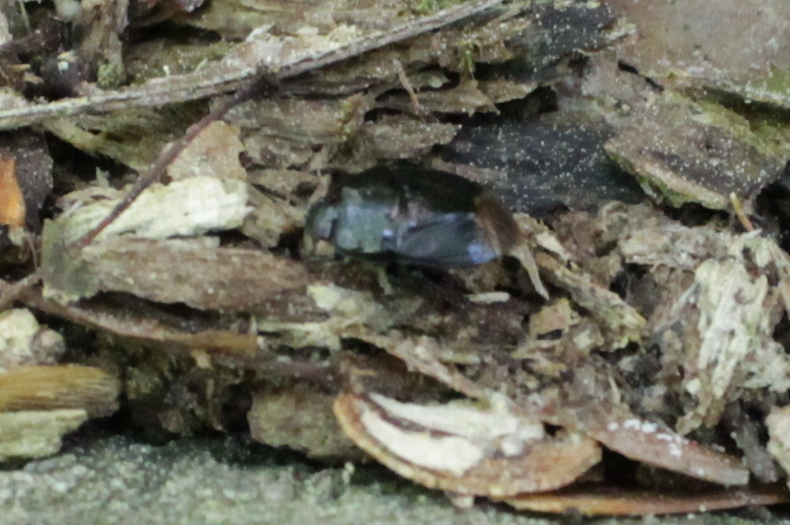
The beetle guy always has such interesting finds, as beetles are such a diverse order.  I found this one near the base of a tree and a whirligig in one of the many small ponds.


This is of course a spittle bug, one of the "true bugs" among many.


The many moths found at Snake Den:


And many ants as well.


No final numbers yet, of course.  I collected bees by hand and found six species, which I tentatively labeled as the genus Bombus impatiens, Bombus sp. 2, Ceratina, Perdita, Sphecodes, and Apis mellifera.  The ant collector found an Agapostemon, I believe.  Another person used "bee bowls", placing bowls with sugar water ever ten? feet for a 150 feet and found bees mostly different from mine.  Most appeared to be from Family Hyalictidae.  We went back and forth trying to identify them, comparing body proportions, abdomen and wing patterns, length of antenna.  I'm only fairly certain of the Ceratine because of it's size and white mark on its face.  It is a difficult task, and the specimens will be going to an entomologist at URI to identify species.


As always, there were amazing varieties of lichen, moss, and mushrooms:


Other unexpected finds were what must have been a 6 foot snake skin and a skeleton of what I was told was a fox.  One of the highlights for me was finally finding a tardigrade!  I found rotifers and nematodes as I often do.  But thanks to Leslie on the Litter Bug team, she found this little guy from a scraping I had taken off an oak tree:


Here's the video:


An more pics of this cutie!  Next time, I'll bring my microscopic camera and hope it works. 


It's a 24 hour experience.  Camping out, I walked to my tent under a full moon, adjusted my sleeping bag so I wasn't facing down-hill, and fell asleep in minutes.  Next year, I'm coming with friends!


Oh, one more thing.  I also collect data for Frog Watch.  Three years ago, all I heard from this man-made pond in an urban spot near 295 were spring peepers.  Last night, there were bull frogs, green frogs, and gray tree frogs.  They were not being quiet.


Thursday, June 8, 2017

Bioblitz 2017


I am very excited about participating in Bioblitz at the Snake Den in Johnston, RI this year!  I am part of the art team and will also be collecting bees for identification and looking for microscopic critters in moss.  Stay tuned...